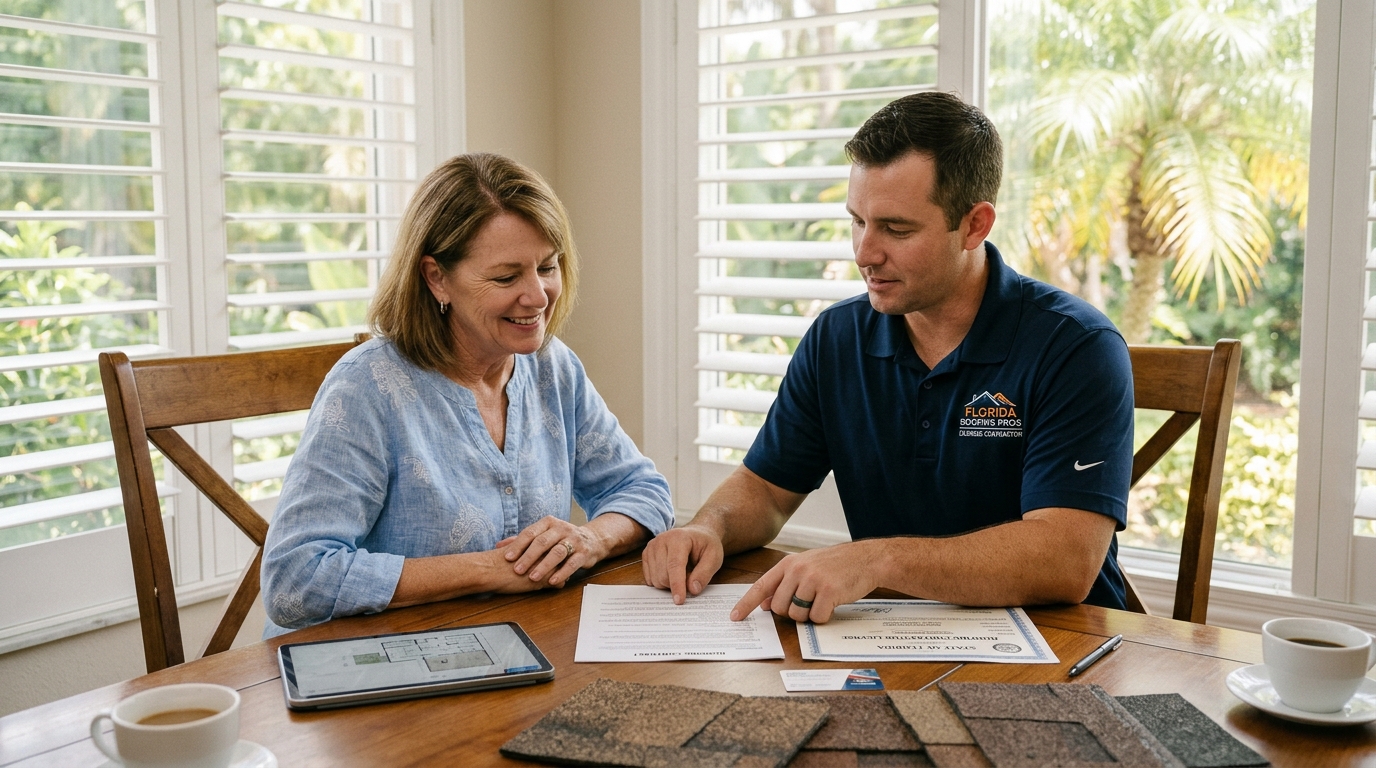
Choosing a roofing contractor in Florida is never just about finding the lowest number at the bottom of an estimate.
The Core Protection Rule: The contractor you hire determines how thoroughly your roof damage is diagnosed, which grade of materials is installed, how structural decking is fastened, and whether required municipal building permits and code inspections are completed. A slick website, branded wrap, or online review score does not substitute for verified state licensing and active workers' compensation coverage.
For Florida homeowners, due diligence is especially critical after major tropical storms. Out-of-state storm-chasing crews flood local neighborhoods, sales reps push aggressive contingency agreements, and promises to waive insurance deductibles create severe legal liabilities for homeowners.
Before handing over a deposit check or signing any paperwork, use this practical guide to independently verify state credentials, evaluate estimates by scope, protect yourself under Florida Construction Lien Law, and spot predatory red flags.
1. Verify the Roofing Contractor's Florida License Through DBPR
Always start with the state's official licensing registry: not a business card, door hanger, yard sign, or verbal claim.
In the State of Florida, all roofing work must be executed by a contractor licensed by the Department of Business and Professional Regulation (DBPR). You can access the official verification registry at MyFloridaLicense.com or review the state's official contractor licensing guidance.
Step 1: Visit MyFloridaLicense.com
Navigate to the DBPR portal and select "Verify a License".
Step 2: Search by License Number
Input the contractor's Certified Roofing Contractor number (e.g., state license number). You can also search by the qualifier's legal name or registered business name.
Step 3: Confirm License Status and Classification
Verify that the status displays "Current, Active". Confirm the license category is Certified Roofing Contractor (CCC) or Registered Roofing Contractor (RC). A standard General Contractor (CGC) or handyman registration does not automatically allow uncertified roofing work.
Step 4: Verify the Qualifying Entity Matches the Proposal
Confirm that the corporate business name listed on your roofing estimate exactly matches the business entity qualified by the licensee on the DBPR record.
Watch for "Rented" Licenses: Under Florida law, a construction business must be actively qualified by a licensed individual. If a salesperson provides a license belonging to an unrelated third party or another company, do not sign. Unlicensed contracting is a crime in Florida and voids your property insurance protections.
2. Check General Liability Insurance and Workers' Compensation
A license confirms technical qualification, but insurance protects your home and financial assets from catastrophic jobsite accidents. Before signing, demand active certificates of insurance:
Commercial General Liability Insurance
General liability protects your property if a crew drops a bundle of shingles through your ceiling, causes structural damage, or leaves an open roof exposed to rain. Demand a Certificate of Insurance (COI) listing your name and address as a certificate holder, and call the independent insurance agency to confirm the policy is active and covers residential roofing operations.
Workers' Compensation Coverage
In Florida, construction employers with one or more employees are legally required to carry workers' compensation coverage. Roofing is physically demanding; if an uninsured laborer slips off your roof, you could face devastating personal injury lawsuits and homeowner liability claims.
Never accept vague assertions like "my guys are independent and have their own waivers." If subcontractors are utilized, demand proof that every individual climbing on your roof is covered by a verified workers' compensation policy.
3. Compare Roofing Estimates by Scope, Not Just Price
Two proposals for the same Tampa residence can vary by thousands of dollars simply because one contractor is omitting essential steps. A cheaper price is no bargain if it leaves off tear-off fees, skips code-required flashings, or excludes rotted plywood replacement.
| Contract Estimate Detail | What Complete Scopes Include | Common Red Flags to Watch For |
|---|---|---|
| Tear-Off and Disposal | Complete 100% removal down to bare decking; haul-away and dump fees included. | Vague wording: extra charges for second layer removal or dumpster rentals. |
| Decking Assessment & Fasteners | Re-nailing entire deck to 6" spacing with 8d ring-shank nails; clear per-sheet wood cost. | No mention of hurricane re-nailing code; open-ended $150+ per sheet wood surprises. |
| Secondary Water Barrier | Direct-to-deck self-adhering modified bitumen membrane (sealed roof deck). | Cheap 15 lb organic felt paper that tears easily in high winds. |
| Drip Edge & Flashing Metal | All new corrosion-resistant aluminum/galvalume drip edge, valleys, and wall step flashing. | Reusing old, rusted, or corroded flashing transitions and wall metal. |
| Penetration Boots & Vents | New lead pipe boots or silicone collars, off-ridge vents, and matching ridge caps. | Painting over old, dried neoprene boots without replacing them. |
| Permits and Code Inspections | Contractor pulls municipal permit, schedules dry-in and final inspections. | Asking the homeowner to pull an owner-builder permit or skipping permitting. |
| Written Warranties | Itemized manufacturer material warranty plus written in-house workmanship warranty. | Vague verbal promises like "we guarantee our work for life" with zero paperwork. |
If you are evaluating shingles, review our shingle roofing service. If your home has concrete or clay tile, see our dedicated tile roofing service.
4. Read the Contract Before Paying a Deposit
Never sign an agreement that leaves crucial terms to verbal understandings. In Florida, your written contract is the sole binding authority governing your project. Ensure the document explicitly details:
Exact Material Specifications
Manufacturer name, specific shingle/metal product line, color, and underlayment type.
Plywood Replacement Pricing
Fixed written price per 4x8 sheet (typically $75 to $110 per sheet installed) for concealed wood rot.
Formal Change Order Protocol
Mandatory requirement that any unforeseen damage must be photographed, priced, and approved in writing.
Project Timeline and Weather Protections
Estimated start window, planned project duration, and written procedures for afternoon rain delays.
5. Understand Deposits, Progress Payments, and Final Payment
How a roofing contractor structures payment milestones is a strong indicator of their financial stability and professional integrity:
- Initial Deposit: In Florida, standard initial deposits range from 10 to 33 percent upon signing to secure permitting and schedule materials. Never pay 50 percent or more upfront before materials arrive.
- Material Delivery Milestone: A progress draw (typically 30 to 40 percent) is reasonable once roofing materials and dumpsters are physically delivered to your property.
- Final Payment Retention: Hold back the final 10 to 20 percent balance until all roofing is completed, the site is swept clean with magnetic rollers, and the municipal building inspector officially signs off on the final permit.
6. Protect Yourself Against Construction Liens
Under Florida's Construction Lien Law (Florida Statutes Chapter 713), suppliers and subcontractors who deliver shingles or labor to your home have the legal right to place a lien on your property if the general contractor fails to pay them, even if you paid the roofer in full.
Consult the official Florida Construction Lien Law guide and protect your home with these safeguards:
Notice to Owner (NTO) Tracking
Suppliers who deliver materials will send you a formal "Notice to Owner". This is standard legal notification that they are supplying materials to your job. Keep these notices organized.
Require Partial Lien Releases With Progress Draws
When paying material draws, demand signed partial lien waivers from the primary material supply house.
Obtain a Final Contractor Affidavit & Final Lien Release
Before issuing your final payment, demand an executed Final Contractor's Affidavit and Final Release of Lien certifying all labor, subcontractors, and suppliers have been paid in full.
7. Know the Roofing Contractor Red Flags in Florida
Be immediately cautious if any contractor exhibits these warning signs:
Major Red Flags to Avoid
- High-Pressure "Today Only" Pricing: Demanding you sign immediately or lose a discount. Legitimate contractors honor written quotes for 30 days.
- Offers to "Waive" or "Rebate" Your Deductible: In Florida, offering to absorb, pay, or rebate an insurance deductible is illegal under Florida Statutes § 817.234 and constitutes insurance fraud.
- Demanding Cash-Only Payments: Contractors who refuse checks or credit cards and avoid written invoices create massive financial risks.
- Asking Homeowners to Pull Owner-Builder Permits: If a contractor asks you to pull the permit yourself, it almost always means they are unlicensed, uninsured, or have outstanding municipal fines.
- Out-of-State License Plates After a Storm: Storm-chasing crews sweep through neighborhoods after hurricanes, collect deposits, and vanish when workmanship leaks arise months later.
8. Check Reviews, References, and the Company's Track Record
Online review ratings are helpful, but investigate deeper than five-star averages:
- Review Consistency Over Time: Look for reviews spanning 3 to 5 years, not a sudden surge of 50 reviews posted within two weeks of a hurricane.
- How Complaints Are Resolved: Read responses to critical reviews. A reputable company responds professionally and demonstrates accountability.
- Local Hillsborough County Presence: Verify a permanent brick-and-mortar physical address in the Tampa Bay area, not a post office box or temporary executive suite.
- Ask for Local Neighborhood References: A trustworthy roofer can readily supply addresses of completed projects in Westchase, South Tampa, Brandon, or Carrollwood.
9. Confirm Permits and Inspection Responsibilities
Under Florida Building Code, all roof replacements and sectional repairs exceeding 100 square feet require a municipal building permit pulled through the City of Tampa or Hillsborough County Building Services.
Ensure your contract explicitly states that the contractor is responsible for pulling the permit, posting the permit placard on site, and scheduling both the dry-in/fastener inspection and final building inspection. Never release final payment until you verify online that the permit status displays "Closed" or "Final Complete".
10. Choose a Contractor Who Explains the Repair, Not Just the Price
An honest contractor bases recommendations on physical diagnostic evidence: showing you attic moisture photos, thermal scans, or drone images of damaged flashing rather than delivering a high-pressure sales pitch.
They will explain whether a targeted roof repair is practical, or whether widespread deterioration justifies a full roof replacement.
Official Roofing Contractor Verification Checklist
Print or check off this summary before signing any Florida roofing agreement:
State License Verified via DBPR
License status is "Current, Active" under Certified Roofing Contractor matching the corporate entity on the quote.
Insurance Certificates Confirmed
Commercial general liability ($1M minimum) and full workers' compensation coverage independently verified with the insurance agency.
Itemized Written Scope of Work
Includes tear-off, secondary water barrier, drip edge, flashing, ventilation, per-sheet wood pricing, and cleanup.
Safe Milestone Payment Terms
Deposit does not exceed 33%, with final payment held until municipal final building inspection passes.
Lien Law Protections In Place
Agreement requires contractor lien waivers and final releases from suppliers before final payment.
No Illegal Deductible Offers
Zero promises to waive or absorb insurance deductibles or submit false damage claims.
Frequently Asked Questions
How do I verify a roofing contractor's license in Florida?
Visit MyFloridaLicense.com and select "Verify a License". Search by the contractor's license number or corporate name. Confirm the classification shows Certified Roofing Contractor (CCC) with an active status, and verify the qualifying individual is legally associated with the company issuing your contract.
What insurance should I demand from a roofing contractor?
Demand a Certificate of Insurance showing active Commercial General Liability ($1,000,000 minimum) and full Workers' Compensation coverage for all crew members. Call the independent insurance agency listed on the certificate to confirm policy status.
How much deposit should I pay a roofing contractor?
In Florida, typical deposits range from 10 to 33 percent upon signing to cover permitting and material logistics. Never pay 50 percent or more upfront, and always withhold the final 10 to 20 percent balance until the project passes final municipal building inspection.
Can a roofing contractor waive my insurance deductible in Florida?
No. Florida law strictly prohibits contractors from waiving, paying, rebating, or absorbing a homeowner's insurance deductible under Florida Statutes § 817.234. Any roofer offering a "free roof" or deductible waiver is committing insurance fraud.
What happens if a roofing contractor does not pay subcontractors or suppliers?
Under Florida's Construction Lien Law, unpaid suppliers or subcontractors can place a mechanic's lien on your home, even if you paid your general contractor in full. Protect yourself by demanding a Final Contractor's Affidavit and Final Release of Lien before paying your balance.
HIRING A ROOFER IN TAMPA BAY?
Get a Transparent Estimate You Can Trust
Roof Work is state-certified and fully insured. We provide detailed line-item scopes, upfront fixed pricing, dedicated in-house mechanics, and complete permit management.