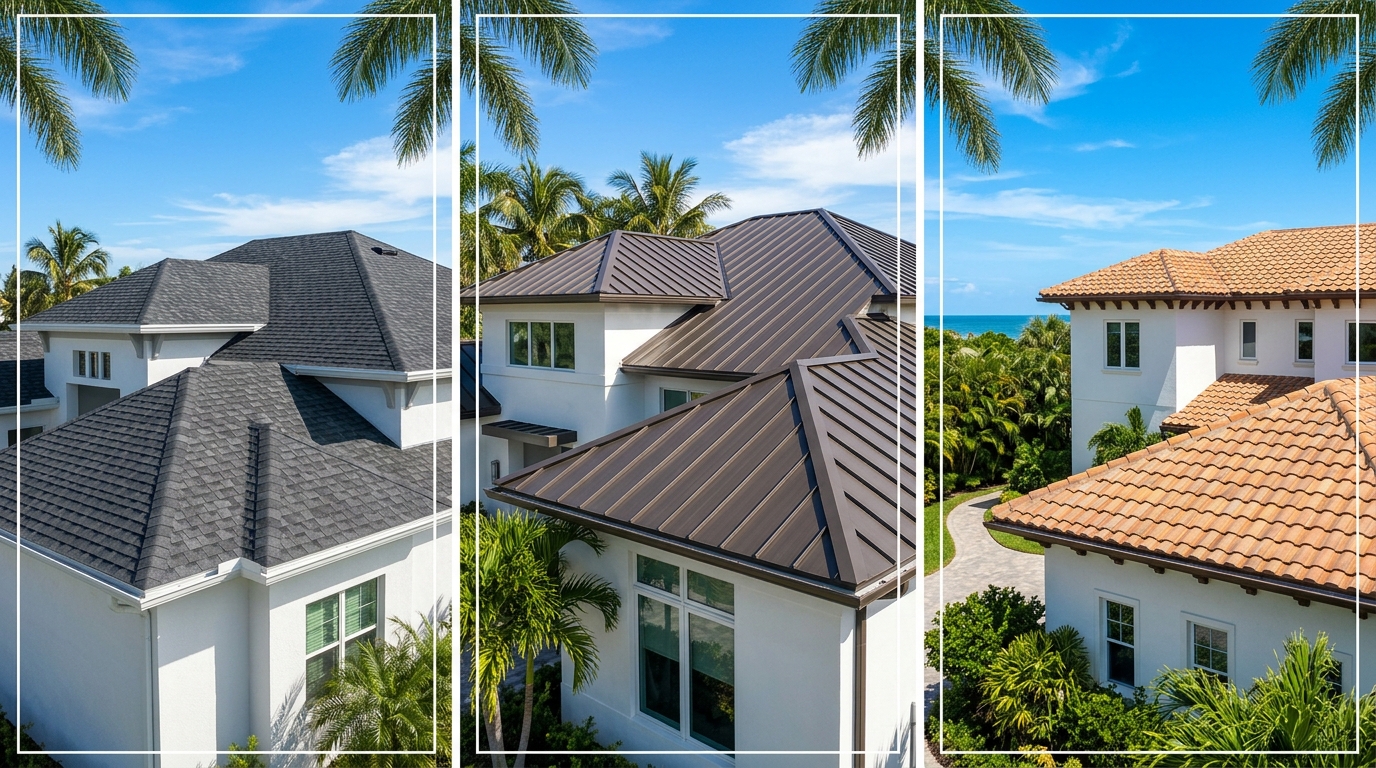
Choosing between a metal roof, tile roof, and asphalt shingle roof in Florida involves much more than comparing shingle colors and initial installation bids.
The Core Decision Reality: Your choice directly dictates your upfront capital investment, long-term maintenance cycles, hurricane wind defense, attic thermal efficiency, and future resale value. In Tampa, where roofs endure intense ultraviolet radiation, tropical downpours, salt fog, and hurricane winds, no single material is universally best for every property. Framing load capacity, neighborhood deed restrictions, and your expected ownership horizon must drive the decision.
For homeowners seeking a cost-effective, versatile solution, architectural asphalt shingles remain the most popular starting point. Standing seam metal appeals to owners prioritizing 40-to-50-year longevity and lightweight storm toughness. Barrel tile delivers unmatched Spanish curb appeal on homes engineered to bear its heavy dead-load.
This definitive guide breaks down each material line by line so you can make an informed, code-compliant investment based on engineering facts rather than contractor sales talk.
Metal vs. Tile vs. Shingle Roof in Florida: Quick Comparison
Use this high-level comparison matrix as your starting point:
| Comparison Factor | Asphalt Shingles | Standing Seam Metal | Concrete or Clay Tile |
|---|---|---|---|
| Initial Upfront Cost | Lowest initial capital investment | Moderate to high investment | Highest initial investment |
| Homeowner Appeal | Practical, budget-conscious, versatile | Modern, maximum durability, low maintenance | Distinctive Mediterranean curb appeal |
| Structural Dead Weight | Relatively light (2.5 to 4 lbs / sq ft) | Very light (1.2 to 2 lbs / sq ft) | Extremely heavy (8 to 12 lbs / sq ft) |
| Wind Uplift Resistance | 110 to 130 mph ratings when hand-sealed | Up to 150+ mph with concealed clips | 130+ mph with foam adhesive attachment |
| Solar Heat & Energy | Absorbs more heat; requires attic venting | Reflective Kynar coatings reduce solar gain | Thermal mass and sub-tile airspace slow heat transfer |
| Routine Maintenance | Inspect for granule loss, lifted tabs, algae | Inspect valley seams, flashing, pipe boots | Inspect cracked tiles, mortar, and underlayment |
| Typical Useful Lifespan | 15 to 22 years in Tampa climate | 40 to 60+ years with Kynar 500 finish | Tiles 50+ yrs; underlayment 20 to 30 yrs |
Important System Fact: The surface material alone does not determine hurricane survival. The complete roofing assembly, including roof decking attachment, ring-shank nail patterns, secondary water barriers, perimeter drip edge, and flashing transitions, determines whether your home stays watertight.
1. Asphalt Shingle Roofs: Are They the Best Budget Option in Florida?
Architectural dimensional shingles remain the standard residential roofing choice across Hillsborough County, installed on approximately 70 percent of Tampa Bay single-family homes. They provide a reliable, aesthetically versatile system at an accessible price point.
Advantages of Asphalt Shingles
- Lowest Upfront Cost: Shingles require the lowest initial capital outlay compared with metal or tile reroofs.
- Broad Style Selection: Available in dimensional, high-definition, and simulated slate profiles in dozens of Florida-friendly color blends.
- Widespread Contractor Familiarity: Installation systems are standardized, though craftsmanship and proper nailing patterns still vary.
- Straightforward Repairability: Individual lifted or damaged shingle tabs can often be repaired without disturbing the entire slope.
- Low Roof Dead Weight: Imposes minimal stress on roof rafters and trusses, requiring no structural reinforcement.
Disadvantages of Shingles in the Florida Climate
Intense ultraviolet radiation bakes the organic asphalt binder over time, causing granule loss, thermal embrittlement, and curling edges. High humidity and morning lake fog promote dark gloeocapsa magma black algae streaks.
Furthermore, standard shingles have a realistic Tampa lifespan of 15 to 20 years before insurance underwriters begin requesting roof certifications or non-renewing policies.
To explore dimensional shingle options and warranties, review our asphalt shingle roofing services.
2. Metal Roofs: Are They Worth the Higher Initial Cost?
Metal roofing has surged in popularity across Tampa, St. Petersburg, and coastal Hillsborough County. Modern architectural standing seam metal delivers remarkable storm resilience, sleek curb appeal, and exceptional thermal reflection.
Advantages of Metal Roofing in Florida
- Unmatched 40 to 60+ Year Longevity: High-grade galvalume and aluminum panels outlast two to three generations of asphalt shingles.
- Exceptional Hurricane Wind Defense: Standing seam systems utilize concealed expansion clips and mechanically seamed vertical ribs that resist gusts up to 150+ mph.
- Ultra-Lightweight Dead Load: At 1.2 to 2 pounds per square foot, metal is lighter than shingles and one-fifth the weight of tile, placing zero stress on trusses.
- Solar Heat Reflection: Cool-roof Kynar 500 reflective pigments reflect up to 70 percent of solar radiation, noticeably reducing summer attic temperatures.
- Fire and Embers Resistance: Class A fire rating provides non-combustible protection against lightning strikes and flying wildfire embers.
Considerations and Coastal Requirements
The primary consideration is upfront price. A standing seam metal roof generally costs 2 to 2.5 times more than an architectural shingle replacement. For homes within 1,500 feet of open saltwater (such as Davis Islands, Beach Park, or Apollo Beach), coastal building codes require marine-grade 0.032-inch or 0.040-inch aluminum panels to prevent salt air edge corrosion.
Discover profile options and coastal specs through our specialized metal roofing services.
3. Tile Roofs: Is Concrete or Clay Tile Right for a Tampa Home?
Concrete and clay tile roofs are iconic across Florida master-planned communities, delivering unmatched Mediterranean, Spanish, and Tuscan architectural beauty.
Advantages of Tile Roofing
- Prestigious Architectural Curb Appeal: Flat, S-tile, and barrel profiles create a luxurious estate appearance that enhances neighborhood property values.
- 50+ Year Tile Durability: The concrete or terracotta tiles themselves can easily survive for 50 to 100 years without deteriorating under sun or rain.
- Natural Thermal Mass: Thick tile units absorb and release heat slowly, creating an insulating thermal buffer over living areas.
- Non-Combustible Class A Protection: Impervious to rot, insect infestation, and fire.
The Tile Reality: Weight and Underlayment Lift-and-Resets
Tile's biggest hurdle is dead weight: concrete tiles weigh 800 to 1,200 pounds per roofing square (100 sq ft). If your home was originally engineered for shingles, an engineer must verify whether your roof rafters and bearing walls can carry the load.
The 20 to 25 Year Lift-and-Reset: While tiles last a half-century, the modified bitumen underlayment underneath them dries out and fails after 20 to 25 years in Florida. When leaks begin, roofers perform a tile lift-and-reset: carefully removing and stacking salvageable tiles, stripping rotted underlayment, installing fresh secondary water barriers, and re-mortaring the original tiles.
Learn more about maintenance and resetting through our tile roofing services.
4. Which Roofing Material Is Best for Florida Hurricane Winds?
No roofing material is completely hurricane-proof. A roof's survival during a major Category 3 to 5 hurricane depends on the engineered attachment system rather than the surface material alone:
| Roof Component | Asphalt Shingles | Standing Seam Metal | Concrete / Clay Tile |
|---|---|---|---|
| Deck Attachment | 8d ring-shank nails at 6" on center | 8d ring-shank nails at 6" on center | 8d ring-shank nails at 6" on center |
| Waterproofing Layer | Self-adhering secondary water barrier | High-temp peel-and-stick underlayment | Heavy-duty modified bitumen membrane |
| Material Fastening | 6-nail high-wind pattern + tar strip | Concealed expansion clips & lock ribs | Expanding polyurethane foam adhesive |
| Wind Uplift Rating | 110 to 130 mph ASTM tested | 140 to 160+ mph TAS 125 tested | 130+ mph FRSA/TRI manual compliant |
| Debris Impact Vulnerability | Punctures or tears on heavy branch impact | Dents under debris; rarely breaches deck | Tiles can crack or shatter on direct impact |
If your roof recently suffered storm displacement, explore our specialized storm damage roof repair. If leaks are minor and localized, schedule residential roof repair services.
5. Will Metal or Tile Roofing Lower Your Florida Homeowners Insurance?
Installing a new roof in Florida often protects you from non-renewal and can qualify you for substantial wind mitigation discounts under the state's Uniform Mitigation Verification Inspection framework (OIR-B1-1802).
However, insurance discounts are driven primarily by documented engineering credits, not just the word "metal" or "tile":
Florida Building Code Roof Covering
Any new roof permitted under current Florida Building Code qualifies for basic roof covering credits regardless of whether it is shingle, metal, or tile.
Roof Deck Attachment (6-Inch Ring-Shank Nailing)
Upgrading decking fasteners from smooth staples to 8d ring-shank nails at 6-inch spacing provides a major wind mitigation discount level.
Secondary Water Resistance (SWR / Sealed Deck)
Installing a direct-to-deck self-adhering modified bitumen underlayment earns the valuable SWR credit on your insurance inspection form.
Consult the official Florida Office of Insurance Regulation guidance and confirm potential discount calculations with your insurance broker before factoring premium savings into your project budget.
6. Which Roof Is More Energy-Efficient in Florida?
Solar heat absorption directly impacts your monthly air conditioning electric bill. In Tampa summers, roof surfaces easily reach 160 degrees Fahrenheit:
- Metal Roofing: Reflects up to 70 percent of incoming solar infrared energy with Kynar 500 cool-roof finishes. The thin metal also dissipates heat rapidly once the sun sets.
- Tile Roofing: Concrete and clay tiles provide natural thermal mass. Air cavities beneath curved barrel tiles create natural convective airflow, venting heat before it radiates into the attic.
- Asphalt Shingles: Standard dark shingles absorb the highest percentage of solar heat. However, modern ENERGY STAR rated "cool shingles" incorporate reflective granules that lower surface absorption by 15 to 20 percent.
Remember that ridge vents, soffit intake airflow, and adequate attic insulation (R-38 or higher) are equally essential in keeping your home comfortable.
7. What Does Metal vs. Tile vs. Shingle Roofing Cost in Tampa?
While actual prices depend on roof square footage, pitch steepness, stories, tear-off layers, and decking rot, homeowners can use these realistic cost ratios to plan their budget:
Architectural Shingles (Baseline: 1.0x)
The most economical investment. Delivers 15 to 22 years of dependable performance with the lowest upfront out-of-pocket expenditure.
Standing Seam Metal (Approx. 2.0x to 2.5x)
Higher initial cost balanced by 40 to 60+ year durability, near-zero maintenance, superior hurricane survival, and lower lifecycle replacement expenses.
Concrete or Clay Tile (Approx. 2.5x to 3.2x)
Highest upfront investment due to heavy materials, specialty labor, foam adhesives, and potential structural reinforcement requirements.
8. Does Your HOA or Roof Structure Limit Your Material Choice?
Before finalizing your material selection, two critical gatekeepers must be verified:
1. HOA Architectural Review Committee (ARC) By-Laws
Many Tampa Bay deed-restricted communities (such as Westchase, Cheval, Carrollwood, or FishHawk) mandate specific roof materials and approved color palettes. Some require concrete tile exclusively, while others prohibit metal roofing entirely. Always obtain written ARC submittal approval before executing a contract.
2. Structural Framing Dead-Load Capacity
If your home currently has shingles, you cannot simply switch to concrete tile without a Florida licensed structural engineering analysis. Rafter sizing, truss plate connections, and load-bearing headers must be evaluated to ensure they can support thousands of pounds of added tile weight.
9. How to Choose the Right Roofing Material for Your Home
Use this simple decision matrix to align your property priorities with the ideal roofing system:
| Your Core Primary Priority | Best Material to Choose | Essential Technical Check |
|---|---|---|
| Budget-Conscious Reroofing | Architectural Asphalt Shingles | Verify 130 mph wind rating and Florida Building Code approval |
| Long-Term 30+ Year Residency | Standing Seam Metal | Specify Kynar 500 finish; use aluminum within coastal salt zone |
| Estate & Mediterranean Style | Concrete or Clay Tile | Verify structural framing capacity and specify premium underlayment |
| Maximum Wind & Hurricane Toughness | Standing Seam Metal | Confirm concealed clip spacing and 6-inch deck ring-shank nailing |
| Lowest Structural Weight | Standing Seam Metal or Shingles | Confirm sheathing thickness (7/16" OSB or 1/2" plywood min) |
For complete technical specifications across all residential systems, explore our certified residential roofing systems.
Frequently Asked Questions
Is a metal roof better than shingles in Florida?
For homeowners planning to live in their home for 15 or more years, metal is often superior due to its 50-year lifespan, 150+ mph wind resistance, and reflective energy efficiency. For budget-sensitive projects or homes planned for resale within 5 to 7 years, architectural shingles remain the more practical financial choice.
Does a tile roof last longer than a shingle roof in Florida?
Yes. Concrete and clay tiles can last 50 to 100 years. However, the waterproofing underlayment beneath them typically requires a lift-and-reset replacement after 20 to 25 years due to Florida attic heat.
Which roof is most hurricane-resistant: metal, tile, or shingles?
Properly engineered standing seam metal generally offers the highest tested wind resistance (up to 160+ mph) without cracking. High-wind shingles resist 130 mph when hand-sealed, while tile resists high winds when adhered with foam adhesive rather than mortar.
Will installing a metal or tile roof reduce my insurance premium?
A new roof permitted under current Florida Building Code qualifies for baseline discounts. Additional credits depend on secondary water resistance (sealed deck) and ring-shank nail patterns rather than the surface material alone.
Can I replace an asphalt shingle roof with tile?
Only if your structural framing can support it. Concrete tile weighs 800 to 1,200 pounds per square, compared to 250 to 350 pounds for shingles. A structural engineer must inspect trusses and bearing walls before converting.
Is a more expensive roof always the better investment?
Not always. If you plan to sell your home in 3 years, you will rarely recoup the premium cost of metal or tile at resale. Match your material investment to your personal ownership timeline and neighborhood home values.
COMPARE MATERIAL OPTIONS WITH EXPERTS
Get an Honest Line-Item Roof Comparison
Speak with our state-certified mechanics to compare shingle, metal, and tile reroofing scopes tailored to your roof structure, budget, and neighborhood HOA rules.