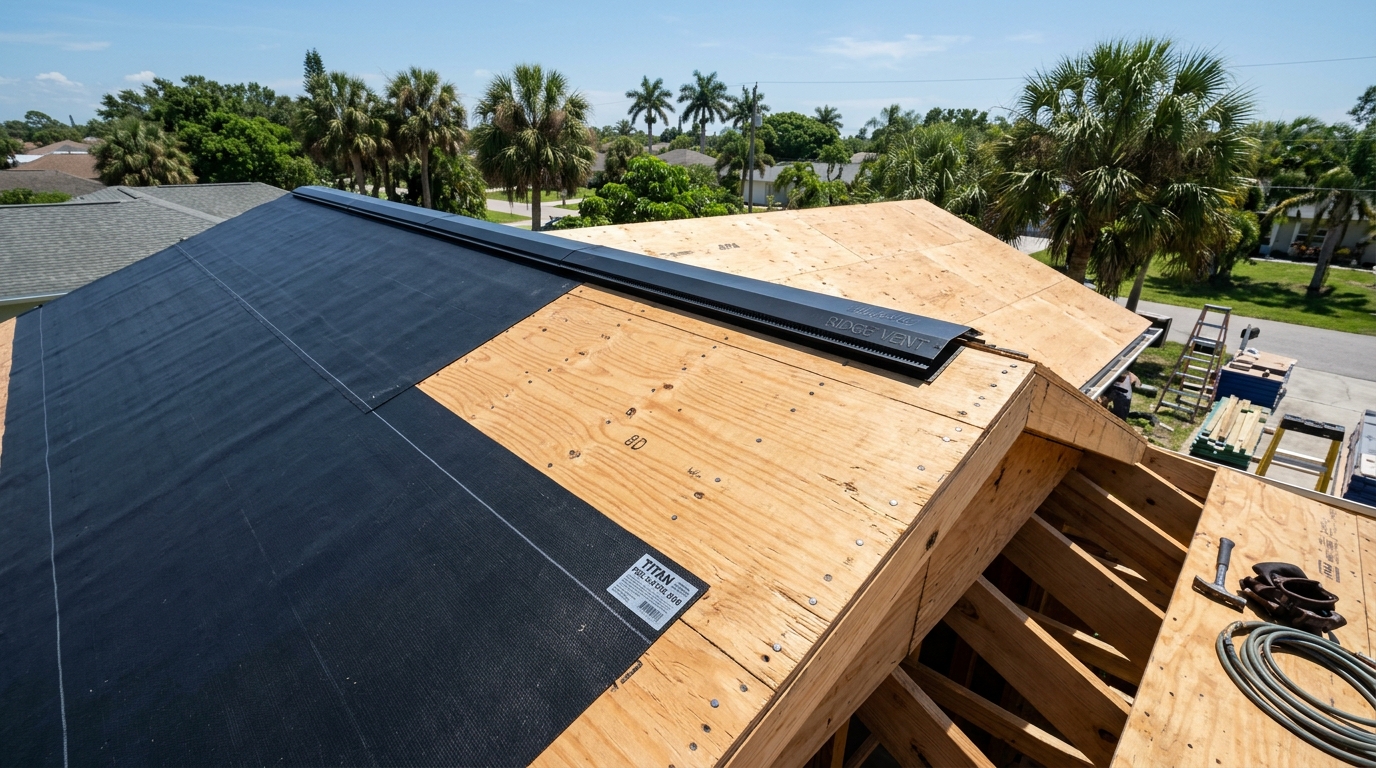
If your asphalt shingle roof is getting older, you may be wondering whether to keep repairing it or start planning for replacement. The answer is not determined by age alone. A roof with a few damaged shingles may still be repairable, while a younger roof with widespread deterioration or repeated leaks may need more extensive work.
Florida's intense sun, heavy rainfall, humidity, and strong winds can put repeated stress on asphalt shingles. The quality of the original installation, attic conditions, storm exposure, and maintenance also affect how long the roof remains serviceable.
So, how long do asphalt shingle roofs last in Florida? Many architectural shingle roofs may provide roughly 15 to 25 years of service, while basic three-tab shingles may have a shorter useful life. These are broad planning estimates, not guarantees for an individual roof.
This guide explains the differences between the two main shingle types, the warning signs worth checking, and how to decide whether a repair or replacement is the more practical next step.
How Long Do Asphalt Shingles Last in Florida?
The lifespan of an asphalt shingle roof depends on the product installed and the conditions it experiences over time. Before estimating how many years your roof has left, identify which type of shingles you have and look at their current condition.
| Shingle Type | Approximate Planning Range | What to Know |
|---|---|---|
| Three-tab asphalt shingles | Often around 12 to 18 years | A simpler, generally thinner shingle design; condition and wind performance depend on the specific product and installation |
| Architectural asphalt shingles | Often around 15 to 25 years, sometimes longer | A dimensional, typically heavier design available in products with different performance ratings and enhanced wind warranties |
Planning note: These ranges are estimates for planning, not expiration dates. A manufacturer's advertised warranty period is not a promise that the roof will perform for that entire period under every climate and installation condition.
For a broader comparison across all roofing materials, see our comprehensive guide to how long a roof lasts in Florida. This article focuses specifically on asphalt shingles and how to evaluate their condition.
How Long Do Three-Tab Shingles Last in Florida?
Three-tab shingles have a relatively flat appearance, with regularly spaced cutouts that create the familiar tabbed pattern. They are generally simpler in construction than architectural shingles, with a lighter asphalt mat.
Their actual service life in Florida depends on product specifications, fastening accuracy, attic ventilation, direct sun exposure, and storm history. In high-wind coastal environments like Tampa Bay, three-tab shingles are rated for lower wind speeds (commonly 60 to 70 mph) and can blow off more easily than laminated shingles.
If you have a three-tab roof approaching 15 years, age alone does not mean you must replace it tomorrow. However, widespread cracking, curling edges, missing tabs, or recurring leaks are clear reasons to arrange an inspection.
What to do: If damage is limited to one small section, ask whether a localized repair is feasible. If deterioration appears across several roof slopes, request an assessment that compares the condition of the entire roof with the likely cost of continued repairs.
How Long Do Architectural Shingles Last in Florida?
Architectural shingles, also called dimensional or laminated shingles, feature two layers of asphalt-bonded fiberglass mats that create dimensional depth and texture. Because of their heavier construction, they carry significantly higher wind resistance ratings (typically 110 to 130 mph with high-wind nailing patterns).
The roof's performance depends on the complete installation, including the selected shingles, fastening pattern (6 nails per shingle in Florida wind zones), secondary water barrier underlayment, drip edge flashing, and balanced ventilation.
What to check:
- Whether shingles remain flat, pliable, and securely bonded to adjacent courses.
- Whether granule loss is isolated to downspouts or spreading across entire slopes.
- Whether shingles show horizontal surface cracks, edge tears, or lifted tabs.
- Whether metal step flashing and pipe boot collars remain watertight.
- Whether interior water marks have appeared in identical or multiple locations.
If you are considering architectural shingles for a replacement, explore Roof Work's dedicated shingle roofing service to evaluate premium algae-resistant and hurricane-rated products.
Why Asphalt Shingle Roofs Age Faster Under Florida Conditions
Florida weather can expose asphalt shingles to repeated heat, moisture, and wind stress. These conditions contribute to physical wear, but they do not affect every roof at the same rate:
1. Intense Sunlight and Thermal Cycling
Florida roof surfaces absorb relentless ultraviolet radiation, with shingle temperatures regularly exceeding 160 degrees Fahrenheit during summer months. Solar heat bakes the volatile oils out of the asphalt layer, making the shingles brittle and prone to micro-cracking.
Attic ventilation plays an essential role. Trapped superheated attic air bakes shingles from the underside, accelerating curling and thermal shock.
What to do: If your shingles are aging unusually fast or you notice excess humidity in the attic, have a technician inspect your soffit intake vents and ridge exhaust airflow together.
2. Strong Winds and Tropical Storms
Tropical wind shear breaks the thermal adhesive sealant strip between shingle courses. Once the adhesive bond fails, shingles flap in the wind, crease along the nail line, and tear away.
A shingle's wind rating applies under lab testing conditions; real-world performance depends heavily on correct nailing depth and nail placement.
What to do: Following strong storms, check your lawn for fallen shingles and scan the roofline safely from the ground. If shingles were torn off, contact our storm damage roof repair team, or call for emergency roof repair if rainwater is entering your home.
3. Heavy Rain and Valley Runoff
Tampa's torrential summer thunderstorms drop heavy volumes of water in short durations. High-volume runoff concentrates in roof valleys and against dormer sidewalls, testing flashing seals.
A ceiling water stain does not always mean shingles directly above have failed; water often enters through a plumbing boot and travels horizontally down rafters before dripping into ceilings.
What to do: Mark stain boundaries with a light pencil line. Schedule a diagnostic roof repair assessment to pinpoint the true water entry path.
4. Improper Nailing and Poor Detailing
Overdriven nails cut through the fiberglass mat, while high nails miss the double-ply nailing zone entirely. In either scenario, shingles can slide out or blow away even during moderate wind gusts.
5. Algae Streaks vs. Damaging Debris
Dark streaks are caused by airborne algae spores (Gloeocapsa magma). While unsightly, algae is primarily cosmetic and does not mean shingles are failing. However, wet pine needles and oak leaves trapped in valleys create organic compost that rots shingles.
What to do: Clean valleys and gutters regularly. Never pressure-wash asphalt shingles; high pressure strips mineral granules and instantly voids manufacturer warranties.
6 Warning Signs Your Asphalt Shingle Roof May Need Attention
A reliable roof inspection distinguishes between cosmetic wear, isolated defects, and systemic failures:
1. Shingles Are Curling or Lifting at the Edges
Curling occurs when the asphalt binder dries out or when attic moisture causes decking movement. Raised shingle corners catch wind easily, leaving the underlayment exposed.
2. Heavy Granule Accumulation in Gutters
Ceramic mineral granules protect shingles from UV degradation. When you see gutters filled with heavy grit and notice dark, bald spots on your shingles, the asphalt core is vulnerable to rapid decay.
3. Shingles Are Cracked, Torn, or Missing
Missing shingles leave the fiberglass backing or felt underlayment bare to sunlight and rain. A small cluster can be replaced with matching shingles if the rest of the roof remains pliable.
4. Leaks Return Repeatedly After Spot Repairs
If caulking or tar patches fail to stop water intrusion, the water is entering upstream through degraded flashing or deteriorated nail seals.
5. Deteriorated Flashing Around Vents or Transitions
Split neoprene plumbing collars, rusted valley pans, and loose chimney step flashing cause the majority of roof leaks, even when shingles themselves are in good shape.
6. Visible Sagging Along the Roofline or Decking
A noticeable dip between rafters signals rotted plywood decking or structural framing movement. This requires immediate attention to prevent structural failure.
When damage spans multiple slopes, evaluate a full roof replacement assessment rather than continuously paying for spot repairs.
Asphalt Shingle Roof Condition and Action Matrix
Use this practical matrix to prioritize your next maintenance step:
| What You Notice | What It May Indicate | Practical Next Step |
|---|---|---|
| A few loose granules after a new roof installation | Normal initial shedding from manufacturing packaging | Monitor downspouts and verify manufacturer specifications |
| Several missing shingles after strong wind gusts | Localized wind uplift or isolated fastener failure | Arrange an immediate roof repair assessment |
| Curling or cracking across multiple roof slopes | Widespread aging, thermal breakdown, or attic heat issues | Request a full roof condition inspection |
| Dark exposed areas where granules are missing | Significant surface weathering exposing asphalt core | Have affected slopes examined for remaining service life |
| A leak near a plumbing vent or chimney transition | Flashing seal failure or split neoprene boot collar | Inspect flashing and replace damaged pipe collars |
| Repeated leaks in different living spaces | Multiple penetrations failing or systemic underlayment wear | Compare cumulative repair scope against replacement options |
| Visible roofline sagging or soft decking underfoot | Structural rafter compromise or rotted plywood substrate | Keep clear and seek prompt professional structural evaluation |
Should You Repair or Replace an Asphalt Shingle Roof?
The right choice depends on physical shingle pliability, underlayment condition, and total project economics, not just calendar age.
When Asphalt Shingle Repair Makes Sense
- Damage is confined to a small, isolated area (e.g., fallen branch impact).
- Adjacent shingles are pliable and can be unsealed without breaking surrounding tabs.
- Roof decking is solid and free of moisture staining or rot.
- The leak stems from an identifiable flashing or pipe collar defect.
For isolated issues, explore Roof Work's specialized roof repair service.
When Replacement Deserves Serious Consideration
- Curling, brittleness, and granule depletion cover multiple roof planes.
- Lifting a shingle to replace a nail causes adjacent shingles to crack.
- Frequent leaks continue occurring in different locations.
- The roof is 18+ years old and your homeowners insurer has requested proof of replacement.
- The cumulative cost of successive repairs approaches the cost of a new warrantied roof.
Always ask for an itemized estimate separating essential repairs from replacement options. For full property solutions, consult Roof Work's roof replacement service and residential roofing team.
Does Florida's 25% Roof Rule Require Complete Replacement?
The Florida Building Code contains provisions commonly termed the "25% roof rule." Under traditional language, if more than 25% of an existing roof section is repaired or replaced within a 12-month timeframe, the entire roof assembly was required to be replaced to current code.
However, recent Florida legislative reforms created key exemptions for roofs built or replaced under post-March 2007 codes that remain structurally sound. Before making assumptions, verify your permit history with your contractor.
Official reference: Florida Building Commission.
Can You Install New Architectural Shingles Over Existing Three-Tab Shingles?
While installing a "roof overlay" (nailing new shingles directly over old ones) is technically allowed by code in some scenarios if only one layer exists, professional Florida roofing contractors strongly advise against it:
- Concealed deck rot: An overlay prevents roofers from inspecting the plywood decking for moisture decay or replacing rotted sheets.
- Shortened shingle lifespan: Trapped heat between the two layers bakes the new shingles, reducing service life by up to 40%.
- Wind vulnerability: Nails must pass through two layers, reducing holding power and leaving shingles vulnerable to tropical wind tear-off.
- Compromised warranties: Most major manufacturers limit or void enhanced wind and algae warranties on overlays.
A clean tear-off allows contractors to inspect every rafter, re-nail plywood with 8d ring-shank nails, install code-mandated peel-and-stick secondary water barriers, and install fresh metal flashings.
Will Replacing Asphalt Shingles Lower Your Florida Home Insurance Premium?
A new roof protects against policy cancellation and can qualify you for valuable Florida wind-mitigation insurance discounts:
- Documented Code Compliance: New architectural shingles installed to current Florida Building Code specifications with valid Florida Product Approval numbers.
- Secondary Water Resistance (SWR): Self-adhering polymer-modified bitumen underlayment protecting decking seams even if shingles blow off.
- Roof Deck Attachment: Decking re-nailed to trusses with 8d ring-shank nails at 6-inch intervals.
Learn more at the Florida Office of Insurance Regulation: Wind Mitigation Resources.
How to Make Your Asphalt Shingle Roof Last Longer
- Clear gutters and valleys: Prevent moisture damming by cleaning leaves and debris twice yearly.
- Address missing shingles immediately: Prevent water from soaking into exposed underlayment.
- Trim overhanging branches: Maintain a 6-foot clearance to prevent limbs from scraping mineral granules off shingles during storms.
- Inspect vent flashings every 3 years: Rubber plumbing boots degrade under Florida UV long before shingles fail.
- Never use high-pressure washers: Clean dark algae stains with gentle, manufacturer-approved chemical soft-washing solutions.
- Keep thorough records: Retain all building permits, contractor paid invoices, and warranty documents in a safe file.
Frequently Asked Questions About Asphalt Shingle Roofs in Florida
How long do architectural shingles last in Florida?
Quality architectural asphalt shingles in Florida typically last 15 to 25 years. Lifespan depends on roof pitch, attic ventilation, hurricane exposure, and whether shingles feature copper-infused algae-resistant granules.
Are three-tab shingles less durable than architectural shingles?
Yes. Three-tab shingles are thinner, single-layer products rated for 60 to 70 mph winds with an expected life of 12 to 18 years. Architectural shingles are dual-layered, rated for up to 130 mph winds, and provide superior impact and tear resistance.
Is granule loss always a sign that my roof is failing?
No. A small amount of loose granule shedding is normal on newly installed roofs. However, persistent heavy deposits in gutters accompanied by shiny or dark bald patches on shingles indicates the protective mineral coating is gone.
Why are my asphalt shingles curling at the edges?
Curling occurs when severe solar heat dries out asphalt oils, making the shingle shrink and pull upward. Inadequate attic airflow also causes shingles to bake from beneath, accelerating curling.
Can I repair a 20-year-old shingle roof in Florida?
If the shingles remain pliable and the damage is confined to a small area like a pipe boot or chimney flashing, localized repairs are viable. However, if shingles are brittle across all slopes, attempting spot repairs will break surrounding shingles.
Is a full tear-off always necessary when replacing shingles?
In Florida, a complete tear-off is highly recommended. It allows contractors to inspect the wood deck, replace rotted plywood, re-nail decking to meet current hurricane codes, and apply code-mandated secondary water barriers.
Get a Clear Recommendation for Your Shingle Roof
If your shingles are curling, granules are accumulating in your gutters, leaks keep returning, or storm winds have torn shingles away, you do not need to guess whether replacement is necessary.
Roof Work provides honest, pressure-free roof evaluations across Tampa Bay and Hillsborough County. We provide clear photographic evidence, explain the condition of your decking and flashings, and help you determine whether a targeted repair or complete replacement makes the most sense.
Need help evaluating an asphalt shingle roof? Contact Roof Work today or call our local office at (813) 845-8300 to schedule your inspection.