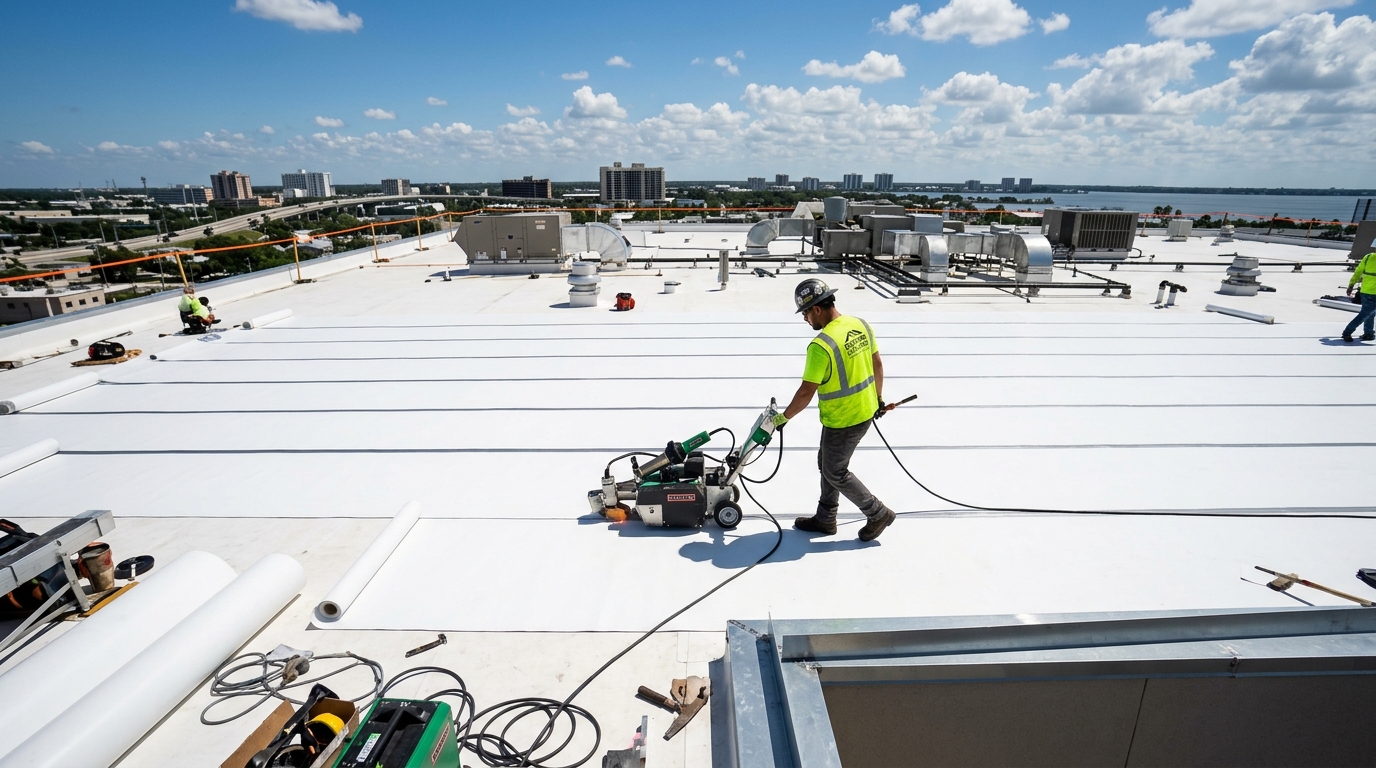
After a heavy Tampa rainstorm, water may remain in low areas of a commercial flat roof long after the rain stops. A small amount of temporary runoff is not necessarily a sign of roof failure. However, water that repeatedly collects in the same area or remains for days deserves investigation.
Executive Briefing: Ponding Water on Florida Low-Slope Roofs
- The 48-Hour Standard: Water standing on a roof for more than 48 hours is classified as ponding by the NRCA and requires professional evaluation.
- Structural Weight Impact: Standing water adds approximately 5.2 pounds per square foot per inch of depth, placing continuous strain on trusses.
- Root Causes: Common culprits include clogged drain strainers, compressed polyiso insulation boards, dead-flat slopes, and HVAC curb dams.
- Cost-Effective Remedies: Tapered insulation crickets, drain sump retrofits, and scupper enlargement resolve standing water without tearing off the entire roof.
For commercial property owners and facility managers, the important question is not simply whether water is visible. It is why the water is not draining, whether moisture has reached the underlying roof assembly, and what repair will prevent the problem from returning.
Ponding can result from blocked drains, inadequate drainage slope, compressed insulation, or defects around roof penetrations and drainage details. These problems require different solutions. Clearing a blocked drain may resolve one issue, while a persistent low spot or water-damaged insulation may require more extensive work.
This guide explains how to identify the likely cause, what a roofing contractor should inspect, and when commercial roof repair may be enough instead of a full replacement.
How Long Can Water Sit on a Commercial Flat Roof?
Commercial flat roofs are usually designed with drainage paths, drains, or scuppers to move rainwater off the building. They are not necessarily perfectly flat, and some temporary water accumulation can occur during or immediately after heavy rainfall.
The key distinction is whether the water drains within a reasonable period or continues to collect in the same locations.
The National Roofing Contractors Association (NRCA) has discussed ponding water that remains for more than 48 hours as a potential concern for low-slope roof assemblies. Treat that timeframe as a practical reason to arrange an inspection, not a universal pass-or-fail test for every roofing system.
Consider the following operational guidelines:
-
1
Water drains shortly after rainfall: Temporary accumulation may reflect the intensity of the storm, but recurring pooling should still be monitored during scheduled semi-annual maintenance.
-
2
The same puddles remain for more than 48 hours: Have the drainage path and affected roof area evaluated by a commercial roofing specialist to prevent premature membrane breakdown.
-
3
Puddles grow larger or appear in new locations: The roof may have an internal drainage restriction, a developing low spot, or structural deck deflection that needs engineering review.
-
4
Water appears inside the building: Ceiling stains, drips, damp insulation, or water near electrical equipment require prompt attention, regardless of how long the exterior puddle has been present.
Do not assume that a roof is healthy simply because the interior ceiling is dry. Water can travel beneath a single-ply membrane or through insulation board joints for dozens of feet before appearing inside the building.
What Causes Ponding Water on Commercial Roofs?
The right repair depends on what is preventing water from leaving the roof. These are the five primary causes a commercial roofing inspection should investigate:
Blocked Drains & Scuppers
Insufficient Roof Slope
Compressed Insulation
Curb & Wall Drainage Obstacles
Damaged Membrane & Failed Seams
Can Ponding Water Damage a Commercial Roof?
Ponding does not automatically mean a roof is failing immediately, but it introduces four major operational risks for commercial properties:
Membrane UV Magnification
In Florida, standing puddles act as magnifying lenses under intense ultraviolet radiation, baking the membrane surface and accelerating plasticizer migration, blistering, and thermal shock.
Hydrostatic Water Intrusion
Static water pressure forces moisture through minor imperfections and flashings, damaging dropped ceiling tiles, drywall, computer servers, and valuable tenant inventory.
Insulation & Deck Corrosion
Wet polyiso insulation permanently loses thermal R-value resistance and traps moisture against steel or wood decking, accelerating structural rust and deck rot.
Excessive Structural Dead-Load
Water weighs approximately 5.2 pounds per square foot per inch of depth. A 1,000 square foot puddle sitting two inches deep adds over 10,000 pounds of static load to building trusses.
How to Identify the Cause of Commercial Roof Ponding Water
Follow these four steps to diagnose the issue accurately before committing repair capital:
Document Where and When Water Collects
Take date-stamped photographs 24, 48, and 72 hours following a storm to map puddle boundaries, measure water depth, and determine if drainage is completely stalled.
Check for Interior Warning Signs
Inspect acoustical ceiling tiles, interior perimeter walls, structural steel purlins, and electrical closets for moisture marks, rust stains, or mold growth.
Conduct a Professional Diagnostic Survey
A commercial roofing contractor uses non-destructive infrared thermography or nuclear moisture meters to detect trapped water in the insulation core without cutting the membrane.
Request an Engineered Scope of Work
Require a written proposal that specifies the root structural or drainage cause and addresses the water flow defect, rather than offering a superficial surface patch or coating.
How to Fix Ponding Water on a Commercial Roof
Matching the corrective action to the confirmed diagnosis is essential for reliable long-term performance:
| Identified Problem | Category | Potential Corrective Action |
|---|---|---|
| Debris blocking a drain strainer or scupper | Maintenance | Clear obstructions, flush underground conductor lines, and install heavy-duty cast-iron strainer domes |
| Defective drain clamping ring or connection | Detail Repair | Re-flash drain bowl with compatible single-ply membrane and install new lead or elastomeric compression seals |
| Localized membrane puncture or seam void | Seam Weld | Heat-weld compatible TPO/PVC patches or apply two-ply modified bitumen target patches |
| Persistent low spot or insufficient slope | Re-Slope | Install engineered tapered polyisocyanurate insulation crickets or auxiliary sump drains |
| Moisture-damaged, compressed insulation or deck | Restoration | Extract wet insulation core, replace corroded metal decking, and reconstruct the roof assembly |
| Widespread membrane breakdown across entire roof | Replacement | Evaluate complete commercial roof replacement with positive drainage engineering |
Does Ponding Water Mean a Commercial Roof Needs Replacement?
No. Ponding water alone does not establish that a commercial roof must be torn off. The right path depends on membrane pliability and insulation moisture levels:
When Repairs Are Sufficient
- Dry insulation: Moisture meter testing reveals dry underlying polyiso core.
- Sound membrane: Seams are tight and single-ply membrane remains flexible.
- Localized depression: Less than 20% to 25% of the total roof area is affected.
- Solvable drainage: Adding tapered crickets or auxiliary sumps restores flow.
When Replacement Is Necessary
- Widespread wet insulation: Thermal imaging shows over 25% moisture saturation.
- Brittle or aged membrane: Widespread seam splitting, crazing, or alligatoring.
- Severe deck sag: Structural deck deflection cannot be corrected with crickets.
- End of service life: The system is past its expected 20-year design lifespan.
If replacement is required, learn about full commercial options through our commercial roof replacement service, or explore our detailed guide on flat roof lifespan in Florida: TPO, modified bitumen, and maintenance.
How to Prevent Ponding Water on a Commercial Roof
Proactive commercial building maintenance prevents small water pockets from escalating into costly interior leaks:
-
Inspect drainage outlets quarterly: Keep strainer domes, internal drain bowls, and exterior conductor heads free of vegetation, leaves, and roofing silt.
-
Install rooftop walkway pads: Protect single-ply membranes around HVAC servicing access points to prevent heavy foot traffic from compressing insulation.
-
Prohibit unapproved rooftop equipment additions: Ensure satellite dishes, solar racking, and conduit runs do not block natural drainage valleys.
-
Maintain official inspection logs: Document all semi-annual maintenance visits and post-storm reports to preserve manufacturer system warranty coverage.
Frequently Asked Questions About Commercial Roof Ponding Water
Is ponding water on a commercial flat roof normal?
Temporary water accumulation immediately following a heavy Florida downpour is normal. However, water that remains in standing pools for more than 48 hours is considered ponding and indicates inadequate slope, blocked outlets, or compressed insulation.
Will applying a silicone roof coating fix ponding water?
Silicone coatings resist ponding water better than acrylics because silicone does not absorb standing water. However, a coating cannot level a low spot, restore drainage slope, or remove moisture trapped in wet insulation. Structural drainage corrections must be completed before applying coatings.
Can ponding water be corrected without replacing the entire roof?
Yes. If the underlying insulation is dry, contractors can clear drain restrictions, install tapered polyiso crickets, or add auxiliary roof drain sumps without tearing off the entire roof assembly.
How much weight does ponding water add to a commercial building?
Water weighs approximately 5.2 pounds per square foot per inch of depth. A two-inch deep puddle over an area of 1,000 square feet weighs over 10,000 pounds, placing significant stress on building trusses and deck supports.