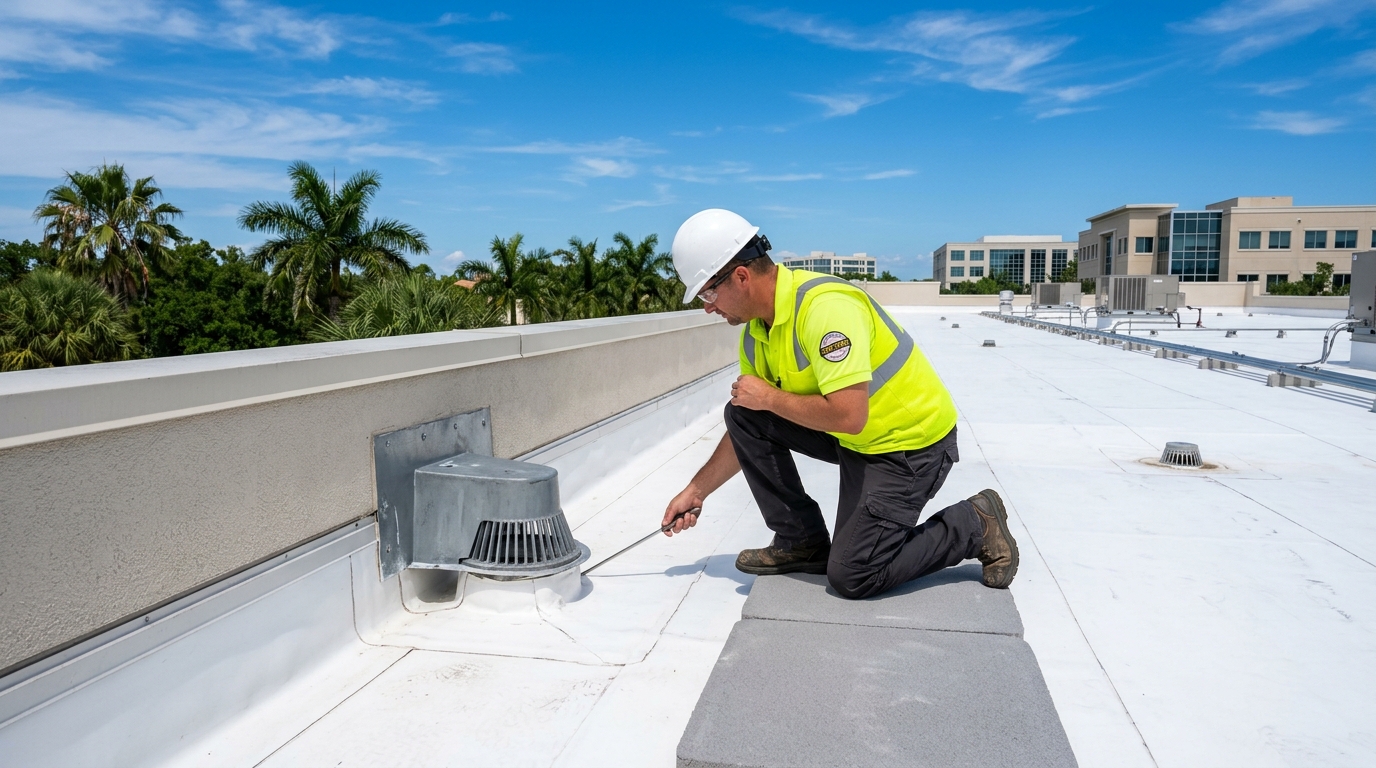
A flat roof can develop a leak even when most of its surface looks intact. Water may collect around a low spot, enter through a deteriorated seam, or work its way into flashing around rooftop equipment. By the time a ceiling stain appears inside the building, the problem may extend beyond the visible roof surface.
In Tampa and throughout Florida, flat and low-slope roofs face intense sun, heavy rainfall, humidity, and periods of severe weather. Their service life depends not only on the membrane but also on drainage, installation quality, flashing, insulation, and the condition of the roof deck.
How long does a flat roof last in Florida? Many commercial roofing systems are designed to provide service for years or decades, but there is no single lifespan that applies to every flat roof. The material, product specifications, workmanship, maintenance, and exposure determine how well a particular roof performs.
This guide explains the differences between common flat roofing systems, how to recognize drainage and membrane problems, and what to ask a roofing contractor before committing to another repair or a full replacement.
How Long Does a Flat Roof Last in Florida by Material?
The first step is identifying which roofing system is installed. TPO, modified bitumen, and built-up roofing use different materials and construction methods, so their maintenance requirements and failure points are not identical.
The ranges below are broad planning estimates, not guaranteed service lives. Manufacturer specifications, warranty terms, installation details, and inspection findings should take priority when evaluating an actual roof.
| Flat Roofing System | Approximate Planning Range | Main Factors Affecting Service Life |
|---|---|---|
| TPO membrane | Around 15 to 25 years or longer in some systems | Membrane quality, seam welding, attachment, drainage, and flashing |
| Modified bitumen | Around 10 to 25 years, depending on the system | Number of plies, installation method, surface protection, seams, and moisture exposure |
| Built-up roofing (BUR) | Around 15 to 30 years in some systems | System design, aggregate or surface protection, drainage, and maintenance |
Planning note: These ranges are intended to help with initial planning. They should not be used to predict an exact replacement year or to determine whether a particular roof is still serviceable without a physical inspection.
How Long Does a TPO Roof Last in Florida?
Thermoplastic polyolefin (TPO) is a single-ply roofing membrane commonly used on commercial and low-slope residential structures. Many TPO products have a bright white reflective surface, which reflects a substantial portion of the sun's solar heat when clean and properly maintained.
TPO sheets are joined using hot-air heat-welded seams. Those seams, along with mechanical fastening or fully adhered bonding, flashing details, and positive drainage slope, form the core of the waterproofing system.
What affects TPO roof longevity?
- Seam quality: Poorly formed cold welds or deteriorating welds create direct openings for moisture.
- Membrane condition: Punctures from dropped tools, HVAC servicing traffic, abrasion, and intense UV degradation can breach the membrane.
- Roof attachment: The specified fastening method (mechanically attached vs. fully adhered) dictates performance during hurricane wind uplift.
- Flashing details: Watertight transitions around internal drains, plumbing vents, HVAC curbs, and perimeter coping are vital.
- Drainage: Persistent ponding water accelerates membrane aging and stresses seam bonds.
A thicker membrane (such as 60-mil or 80-mil) is not automatically required for every building, but higher mil thicknesses offer greater puncture resistance and extended weathering capability under harsh Florida UV exposure.
What to do: If you notice separated seams, punctures, or recurring leaks on a TPO roof, have the affected section inspected before applying generic asphalt mastic or silicone sealants. TPO requires compatible thermoplastic repair patches and heat-welding techniques. Roof Work's commercial roofing service is an ideal resource for evaluating commercial low-slope systems.
How Long Does a Modified Bitumen Roof Last in Florida?
Modified bitumen is an asphalt-based roofing system reinforced with heavy fiberglass or polyester scrims. Depending on the product and engineering requirements, it may be installed in two or three plies (base sheet, interply, and granule-surfaced cap sheet) using hot asphalt, cold adhesive, or heat-welded torch applications.
Its durability depends heavily on more than just the visible cap sheet. Common modified bitumen issues include:
- Open or delaminated side laps and end laps.
- Blisters, bubbles, or wrinkles caused by trapped air or moisture vapor.
- Alligatoring, cracks, or loose mineral ceramic granules exposing asphalt to solar radiation.
- Deteriorated lead pipe flashing or metal edge delamination.
- Moisture trapped between ply layers or within rigid polyisocyanurate roof insulation.
Not every surface blister requires replacing the whole roof. However, slicing or patching a blister without identifying the underlying moisture source will leave the roof vulnerable to deck decay.
What to do: Request that your contractor identify how many layers are compromised, whether moisture has penetrated the wood or concrete decking, and whether localized two-ply torch repairs can restore integrity. If leaks recur across multiple roof sections, review Roof Work's specialized roof repair service to evaluate your options.
How Long Does Built-Up Roofing (BUR) Last in Florida?
Built-up roofing (BUR), historically known as tar and gravel roofing, is a multi-ply system composed of alternating layers of bitumen and reinforcing felts, topped with flood coats and aggregate gravel or mineral protective cap sheets.
While the redundant multiple plies provide substantial resistance to foot traffic and physical puncture, they do not make the roof immune to severe drainage failures or hidden moisture entrapment.
What to do: If an older gravel-surfaced built-up roof develops recurring interior leaks, bare spots in aggregate surfacing, or spongy walking areas, arrange a comprehensive diagnostic survey. A surface patch may seal an isolated puncture, but widespread embrittlement requires evaluating a full recover or tear-off.
Why Ponding Water Is a Major Flat Roof Problem in Florida
Flat roofs are never truly flat; they are engineered with deliberate low-slope drainage provisions (typically a minimum 1/4 inch per foot slope) to channel rainfall toward scuppers, interior roof drains, or perimeter gutters.
Serious problems develop when the drainage system becomes restricted or when the roof structure sags, forming localized birdbaths that retain standing water.
What Is Ponding Water on a Flat Roof?
Ponding water is water that remains on a low-slope roof surface after precipitation. The Florida Building Code defines positive roof drainage as drainage design that accounts for structural deck deflection and ensures standing water evaporates or drains away within 48 hours under typical climatic conditions.
However, that 48-hour reference should never be an excuse to ignore deep or expanding pools of standing water. Recurring standing water adds heavy structural dead load (water weighs approximately 5.2 pounds per square foot per inch of depth), accelerates chemical breakdown of asphalt and single-ply membranes, and promotes organic algae growth.
Official reference: Florida Building Code development resources.
Why Does Water Collect on a Florida Flat Roof?
- Blocked drains and scupper boxes: Fallen leaves, wind-blown debris, and silt quickly clog strainer baskets, backing up water across the roof deck.
- Structural deck deflection and settlement: Aging wood trusses or metal purlins can settle under equipment loads, creating depressions that cannot drain.
- Inadequate slope or poor drain placement: Original roof designs may not have included tapered insulation packages to move water around HVAC curbs and perimeter parapets.
- Crushed or saturated insulation: Wet polyiso insulation boards collapse under foot traffic, creating sunken basins that capture rainwater.
Can Ponding Water Damage a Flat Roof?
Yes. Chronic ponding acts as a magnifying glass under intense Florida UV rays, accelerating surface oxidation. In modified bitumen roofs, ponding dissolves asphalt oils, leading to delamination. If seams have microscopic gaps, static hydrostatic water pressure forces moisture into the insulation and living spaces below.
If active leaks are threatening your inventory, equipment, or interior drywall, arrange an immediate response through our emergency roof repair service.
Flat Roof Seams, Flashing, and Other Common Failure Points
A commercial flat roof rarely fails across the open expanse of the membrane first. Instead, failures almost always originate at joints, perimeters, and equipment transitions:
TPO Seam Separation
Single-ply TPO relies entirely on hot-air fusion welds. If the original installer welded seams with dirty membrane surfaces, improper robotic temperature settings, or insufficient roller pressure, seams can pop open under thermal stress or storm uplift.
Next step: A technician must probe seam edges with a dull cotter-pin tool to identify voids and re-weld or strip in fresh membrane covers.
Modified Bitumen Lap Failure
Laps require sufficient asphalt compound bleed-out during heat welding or uniform troweling with commercial cold adhesive. Dried mastic or unbonded edge laps create direct conduits for wind-driven rain.
Flashing Around HVAC Units and Pipe Stacks
Rooftop air conditioning compressors, chillers, exhaust fans, and conduit pipes constantly vibrate during operation. That mechanical vibration stresses metal counterflashing, separates caulked termination bars, and breaks corner pitch pockets.
Parapet Walls and Coping Caps
Wind uplift is strongest along exterior parapet wall perimeters. Loose metal coping caps, cracked masonry mortar joints, or detached membrane termination bars allow hurricane rains to bypass the roof surface entirely and pour directly into exterior wall cavities.
When widespread flashing breakdown accompanies degraded field membranes, evaluate full roof replacement rather than repeatedly spending capital on isolated caulking band-aids.
Flat Roof Inspection Checklist for Florida Property Owners
Property managers and building owners can use this visual checklist to document symptoms from safe observation points (such as rooftop access hatches or adjacent windows). Never climb onto an unbarricaded roof or walk near unprotected edges.
- Drainage and Water Movement: Document where standing water pools remain 48 hours after rain. Check whether drain strainer domes are clear of trash and leaves.
- Membrane Surface Condition: Note visible tears, splits, blisters, surface wrinkles, or bare patches where aggregate or granules have washed away.
- Perimeter and Flashing Details: Inspect metal edge termination bars, curb corners, and plumbing pipe boot clamps for rust, loose screws, or peeling sealant.
- Interior Warning Signs: Inspect acoustical ceiling tiles for water stains, peeling paint on perimeter walls, musty odors in air ducts, or visible drywall sagging.
- Maintenance History Records: Compile original warranty certificates, installation permits, past repair invoices, and inspection photographs.
How Often Should a Commercial Flat Roof Be Inspected in Florida?
For most Florida commercial properties, a proactive preventative maintenance schedule involves professional inspections at least twice a year: once in spring (before the June 1 hurricane season kickoff) and once in late fall (after the summer rainy season concludes).
Additional inspections should follow any major named tropical storm or hurricane that brings sustained tropical storm force winds (39+ mph) to Hillsborough County.
When Is Infrared Moisture Testing or Core Sampling Justified?
Because visual observations cannot reveal whether water is trapped beneath an intact top membrane, technicians use non-destructive infrared thermography or physical core cuts.
Infrared scans detect temperature differentials between dry insulation and wet insulation as the roof cools after sunset. Core sampling involves removing a small circular plug of the roof assembly down to the structural deck to verify moisture saturation and deck condition. Core cuts must be immediately sealed with compatible materials.
Should You Repair or Replace a Flat Roof?
A commercial flat roof should never be condemned simply based on chronological age, nor should a younger roof be blindly repaired if structural components are decaying. Consider this decision framework:
| Inspection Finding | What to Discuss With the Contractor |
|---|---|
| One isolated puncture or small localized tear | Compatible heat-welded TPO patch or two-ply modified bitumen target repair |
| A separated seam or split flashing at an HVAC curb | Re-welding seam voids, installing new termination bars, and renewing sealants |
| Blocked drains, scuppers, or debris dams | Drain clearing, installing heavy-duty strainer baskets, and routine gutter maintenance |
| Repeated ponding water in identical low spots | Installing tapered polyiso cricket packages or adding supplemental roof drain sumps |
| Moisture detected within insulation boards | Assessing square footage of wet insulation to determine if localized tear-out is feasible |
| Leaks occurring in multiple unrelated building zones | Evaluating whether membrane embrittlement warrants complete system replacement |
| Widespread membrane failure or recurring unsuccessful repairs | Comparing total cumulative repair expenses against a warrantied roof replacement |
Can You Put a New Flat Roof Over the Existing One?
In Florida, installing a roof recover (placing a new single-ply membrane over an existing roof with a separating cover board) can be code-compliant and cost-effective under specific conditions.
However, Florida Building Code limits the number of permitted roof systems (generally a maximum of two roof coverings on any structure). Furthermore, recovering over wet insulation or rotted decking is illegal and guarantees premature system failure. A full moisture survey must verify that the existing roof substrate is 100% dry and structurally sound before an overlay can be permitted.
For comprehensive replacement details, explore Roof Work's roof replacement service.
How to Extend the Service Life of a Flat Roof
- Keep drains, scuppers, and conductor heads unobstructed: Schedule quarterly maintenance cleanings to prevent silt build-up and vegetation growth.
- Seal minor seam and flashing defects immediately: Prevent water from reaching underlying insulation, where moisture spreads horizontally across hundreds of square feet.
- Control rooftop foot traffic: Restrict roof access to authorized personnel, install walk pads between roof hatches and mechanical equipment, and verify HVAC contractors do not puncture membranes with screws or access panels.
- Maintain comprehensive documentation: Keep full records of manufacturer warranties, city permits, certified inspection logs, and post-storm assessments.
- Conduct post-storm walk-throughs: Inspect roofs immediately after severe weather events using Roof Work's specialized storm damage roof repair team.
Frequently Asked Questions About Flat Roof Lifespan in Florida
How long does a flat roof last in Florida on average?
There is no single lifespan for Florida flat roofs. High-performance single-ply TPO roofs typically last 15 to 25 years or longer, multi-ply modified bitumen systems provide 10 to 25 years, and traditional built-up asphalt roofs endure 15 to 30 years with diligent preventative maintenance.
Is ponding water always an emergency on a flat roof?
Shallow water that evaporates within 48 hours of rainfall meets standard positive drainage guidelines. However, standing water that remains deeper than one inch, lasts several days, or causes structural deflection requires prompt technical investigation to prevent membrane delamination and deck rot.
Is a 20-year-old flat roof too old to repair?
Not necessarily. If the membrane remains pliable, seams are tight, and insulation is dry, isolated flashing repairs or drain seal renewals can extend service life several more years. However, if the membrane is brittle and insulation is saturated across multiple bays, replacement is far more economical.
Can a flat roof be repaired if water has entered the insulation?
Yes, provided the moisture is localized. Technicians can cut out the saturated insulation boards, inspect and dry the deck, install fresh polyiso insulation, and tie in a compatible membrane patch. If widespread saturation is detected, a full tear-off is necessary to prevent structural rot.
Does a white reflective TPO roof automatically lower power bills?
White TPO reflects up to 80% of solar radiation, reducing rooftop surface temperatures significantly compared to dark asphalt. However, actual building energy savings depend on overall building insulation R-value, HVAC efficiency, ceiling plenums, and roof maintenance cleanliness.
Arrange a Flat Roof Assessment Before the Damage Spreads
If your flat roof repeatedly collects water, develops seam separations, leaks around rooftop HVAC equipment, or needs repairs across several locations, the next step is to establish the cause, not simply cover the visible damage with temporary coatings.
Roof Work provides honest assessments, commercial diagnostic surveys, and code-compliant roofing solutions for commercial and residential flat roof properties across Tampa Bay and Hillsborough County.
Need help evaluating a flat roof leak or recurring ponding water problem? Contact Roof Work to discuss your roof and request a detailed, transparent proposal, or call our local team directly at (813) 845-8300.
Explore Our Pillar Roofing Guide
Comparing multiple roofing materials for your residential or commercial property? Read our comprehensive pillar article: How Long Does a Roof Last in Florida? Lifespan by Material.