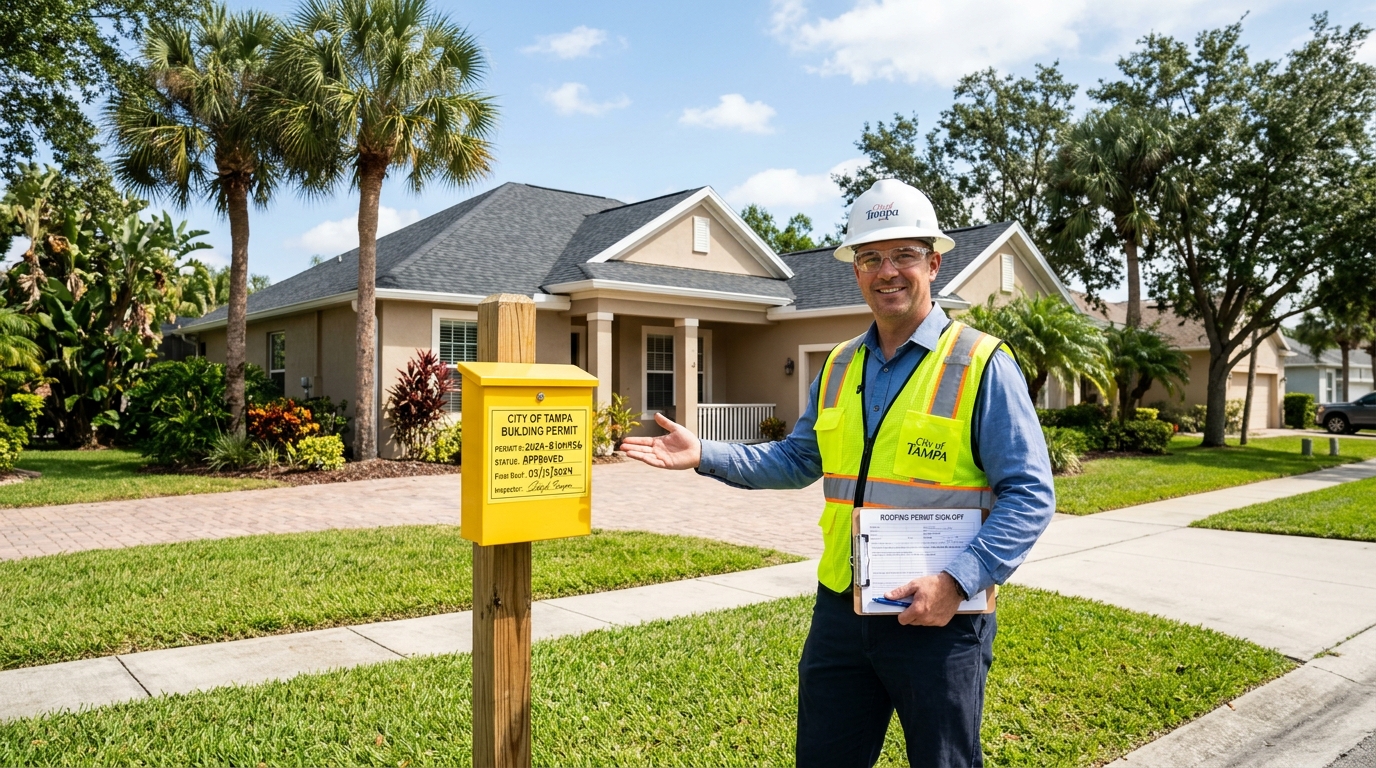
Planning a roof replacement in Tampa? Before work begins, make sure you know who is responsible for pulling the permit, which municipal inspections your project requires, and how you will confirm the permit is officially closed when the job is finished.
These details matter because paying for a new roof and completing the physical installation are not the only steps in a permitted project. You also need to confirm that required local building approvals have been completed and that you possess the permanent records to prove it.
If you are comparing roofing proposals, do not just ask, "How much will the new roof cost?" Ask who will pull the permit under their license, how in-progress dry-in inspections will be handled, and what closeout documentation you will receive.
Roof Works is a family-owned roofing business with more than 34 years of experience in the Tampa roofing industry, focused on residential roof repairs, complete re-roofing, and light commercial roofing. This guide explains how Tampa homeowners can verify contractor credentials, track a roof replacement permit online, and confirm final municipal sign-off.
1. Does a Roof Replacement Need a Permit in Tampa, Florida?
Yes. Under the Florida Building Code, any roof replacement covering more than 500 square feet or involving more than 25% of the total roof surface legally requires a building permit.
The exact permitting process depends on your property location and scope of work:
-
1
City of Tampa Jurisdiction: The city publishes dedicated submittal guidelines for residential roof-covering replacements, detailing fees, plan reviews, and mandatory inspections. Explore official guidance on the City of Tampa Roof Covering Replacement Portal.
-
2
Hillsborough County Jurisdiction: Unincorporated areas (such as Brandon, Riverview, Valrico, and Carrollwood) follow county re-roof requirements. Review official submittals on the Hillsborough County Re-Roof Inspection Portal.
A contractor's verbal assurance that "everything is handled" is not a substitute for verifying the permit yourself. Before signing an agreement, require your contractor to identify the permitting authority, confirm they are pulling the permit under their state license, and verify whether permit fees are included in your written proposal.
2. City of Tampa vs. Hillsborough County: Which Permit Portal Should You Use?
A Tampa mailing address does not automatically mean your home sits within the City of Tampa's municipal limits. Many properties with Tampa addresses are located in unincorporated Hillsborough County, which operates under an entirely different permitting system.
If Your Home Sits Within City of Tampa Limits:
Check the City of Tampa Construction Services portal. To look up your live permit record, use the city's Accela Citizen Access portal. Search using your street address or the 10-digit permit number to view inspector notes and approval dates.
If Your Home Sits in Unincorporated Hillsborough County:
Use the county's online portal, HillsGovHub. Search by parcel folio number or permit ID to review progress check milestones and final inspection sign-offs.
3. How to Verify a Roofing Contractor's License in Florida
Never pull a homeowner-builder permit for a contractor, and never allow an unlicensed crew on your roof. Always independently verify licensing credentials before signing a proposal:
-
1
Check the State License on DBPR: Visit the official Florida DBPR License Search. Verify that the license begins with the prefix CCC (Certified Roofing Contractor), confirm it is in Current, Active status, and verify that the business name exactly matches your contract.
-
2
Verify Workers' Compensation Coverage: Ensure the contractor carries active statutory workers' compensation for all roof mechanics. Uninsured workers injured on your property can file claims against your homeowner's liability insurance.
-
3
Check General Liability Insurance: Demand a Certificate of Insurance (COI) showing at least $1,000,000 to $2,000,000 in general liability protection sent directly from the contractor's insurance broker.
-
4
Verify Local Registration: Confirm that the contractor is registered with the City of Tampa Construction Services Department to pull permits locally.
Compare these standards with our transparent scope on our roof replacement service page.
4. What Roofing Inspections Should You Expect During a Tampa Roof Replacement?
Permitted roofing projects involve two critical inspection milestones to ensure compliance with Florida Building Code wind-uplift and secondary water barrier standards:
1. Dry-In or In-Progress Roof Mitigation Inspection
This inspection evaluates the structural roof deck and underlayment before the outer shingles or tiles are installed:
- Deck re-nailing verification: Verifies that plywood sheets are nailed to trusses using 8d ring-shank nails spaced at 6 inches on center along edges and field rafters.
- Secondary Water Barrier (SWB): Verifies that an approved self-adhering polymer-modified bitumen membrane (ASTM D1970) or approved sealed-deck tape system is applied.
- Mitigation Attestation: The City of Tampa and Hillsborough County permit licensed roofing contractors to submit an official Roof Mitigation Verification Statement with date-stamped photographic affidavits in lieu of an in-person physical inspector visit for certain shingle systems.
2. Final Municipal Roof Inspection
Conducted after all shingles, metal panels, valleys, drip edges, and ridge vents are fully installed. A city or county building inspector reviews the roof from a ladder to confirm code compliance and verify that all debris has been cleared.
Never assume the final inspection has passed simply because the roofing crew finished nailing and loaded their dumpster. Check the City of Tampa inspection portal or Hillsborough County inspection page to confirm that the official status reads Approved or Finaled.
5. How to Check Whether Your Roof Replacement Permit Is Closed
After your roofer announces completion, take these six steps to verify official permit closure:
Access Your Official Municipal Portal
Open City of Tampa Accela or Hillsborough County HillsGovHub on your computer or smartphone.
Search by Address or Permit Number
Enter your house number and street name. Confirm the parcel and permit description match your roofing project.
Review the Inspection History Log
Click on the inspections tab. Confirm that both the in-progress mitigation and final roof inspections show Passed status.
Confirm Overall Record Status
Ensure the overall permit record status states Closed, Completed, or Finaled, rather than Issued, Active, or Pending.
Resolve Outstanding Punch Items
If an inspection failed or shows a correction notice, notify your contractor in writing immediately to schedule a re-inspection.
Save the Final Inspection Certificate
Download and print the official inspection completion certificate for your permanent home insurance file.
6. What Happens If a Roofing Contractor Leaves a Permit Open?
If a contractor completes physical work but fails to schedule the final inspection or submit required dry-in affidavits, the permit remains open on county records.
An open permit creates serious legal and financial headaches:
-
1
Blocks home sales: Title companies search municipal records during closing. An open roofing permit will halt closing until resolved.
-
2
Delays refinancing: Mortgage lenders will refuse to fund loans on properties with open construction permits.
-
3
Threatens insurance coverage: Florida homeowners insurance carriers require proof of a closed permit and final inspection before issuing full hurricane coverage.
7. Does a Closed Roof Permit Guarantee an Insurance Discount?
No. A closed building permit and a Wind Mitigation Inspection serve two completely different legal purposes.
A building permit confirms that your roof meets local life-safety and building code minimums. A Wind Mitigation Inspection (Form OIR-B1-1802) is a specialized insurance inspection documenting storm-hardening features (such as 8d ring-shank nail spacing, secondary water barrier peel-and-stick, and roof-to-wall hurricane clips).
Florida law requires insurers to provide discounts for certified wind-mitigation features. Review the official inspection form on the Florida Department of Financial Services Wind Mitigation Portal.
After your roof replacement is finaled, hire a licensed wind mitigation inspector or request that your roofing contractor provide a signed, date-stamped mitigation packet to submit to your insurance carrier.
8. Homeowner Checklist: What to Keep Before, During, and After Re-Roofing
Keep these essential documents organized in a digital and physical folder:
Before Construction Begins:
-
1
State license verification printout from Florida DBPR (showing active CCC license).
-
2
Certificate of Insurance showing workers' comp and liability coverage with you as certificate holder.
-
3
Executed written contract detailing exact shingle brand, underlayment type, and wood replacement rates.
-
4
Confirmed building department jurisdiction (City of Tampa vs. Hillsborough County).
During Active Work:
-
5
Official municipal permit card posted visibly on your property.
-
6
Permit tracking number saved on your smartphone.
-
7
Date-stamped photographs of bare plywood re-nailing and peel-and-stick underlayment.
-
8
Written, signed approvals for any rotten wood change orders.
After Final Completion:
-
9
Official city or county building department final inspection sign-off certificate.
-
10
Completed Uniform Mitigation Verification Inspection Form (OIR-B1-1802).
-
11
Contractor's written workmanship warranty and registered manufacturer shingle warranty.
-
12
Final paid invoice and executed Final Release of Lien waiver.
9. What to Ask Before Choosing a Roof Replacement Contractor
Who will be listed as the contractor of record on the building permit?
Verify that the company you are hiring pulls the permit under their own Florida CCC license, not a secondary third party.
Who schedules the required in-progress and final inspections?
Ensure the contractor manages all municipal appointments and takes responsibility for addressing any inspector punch items.
Are all municipal permit fees and notice of commencement filings included?
Confirm that permit fees, surcharge costs, and county notary filings are clearly included in your quoted base price.
How are rotted plywood decking sheets documented and approved?
Require date-stamped digital photographs of damaged wood before any replacement plywood is installed.
Will you provide an executed Final Release of Lien upon project completion?
A lien release protects you against supplier or subcontractor claims after you pay your roofing contractor.
How can I independently verify your final permit sign-off?
Your contractor should provide the online portal link and permit tracking number so you can confirm closure directly.
Frequently Asked Questions
Does a roof replacement require a permit in Tampa?
Yes. Under the Florida Building Code, any roof replacement covering more than 500 square feet or 25% of the total roof surface legally requires a building permit from either the City of Tampa or Hillsborough County.
How do I check a roof replacement permit in Tampa?
Use the City of Tampa Accela Citizen Access portal if your home is within city limits. If located in unincorporated Hillsborough County, search the HillsGovHub portal using your address or permit tracking number.
How can I verify a Florida roofing contractor's license?
Visit the official Florida Department of Business and Professional Regulation (DBPR) portal. Enter the contractor's CCC license number, verify that the status is Current and Active, and match the business entity to your contract.
What if my roofing contractor does not close the permit?
Send a certified written request demanding that the contractor complete all open inspections within 14 days. If they fail to comply, contact your local building department to schedule a final inspection or file a complaint with the Florida DBPR.
Is a final roof inspection the same as a wind mitigation inspection?
No. A final roof inspection confirms municipal building code compliance. A wind mitigation inspection is a specialized insurance survey (Form OIR-B1-1802) required by carriers to qualify for hurricane insurance premium discounts.
Should I keep my roofing permit records after the project is finished?
Yes. Retain your closed permit certificate, final invoice, and wind mitigation report permanently. You will need them when renewing homeowners insurance or selling your home.
Planning a Roof Replacement in Tampa? Start With a Clear Scope of Work
A roof replacement is a major structural investment. You should know exactly what materials are being installed, who is pulling the permit, and how inspections will be verified.
Roof Works is a family-owned roofing contractor with more than 34 years of experience in the Tampa roofing industry. We pull all required permits under our own state license, document all dry-in re-nailing phases with date-stamped photos, coordinate all city and county building inspections, and provide permanent closeout documentation.
Explore our full roof replacement service, check our architectural shingle roofing options, or review our tile roofing systems. If you only require localized repairs, see our roof repair service or storm damage restoration.
Check our related educational guides on How to Compare Roofing Estimates Line by Line, Roof Replacement Change Orders, Florida Insurance Roof Age Rules, and Roof Leaking With No Visible Damage.
Request a Permitted Replacement Estimate → Or call direct: (813) 845-8300