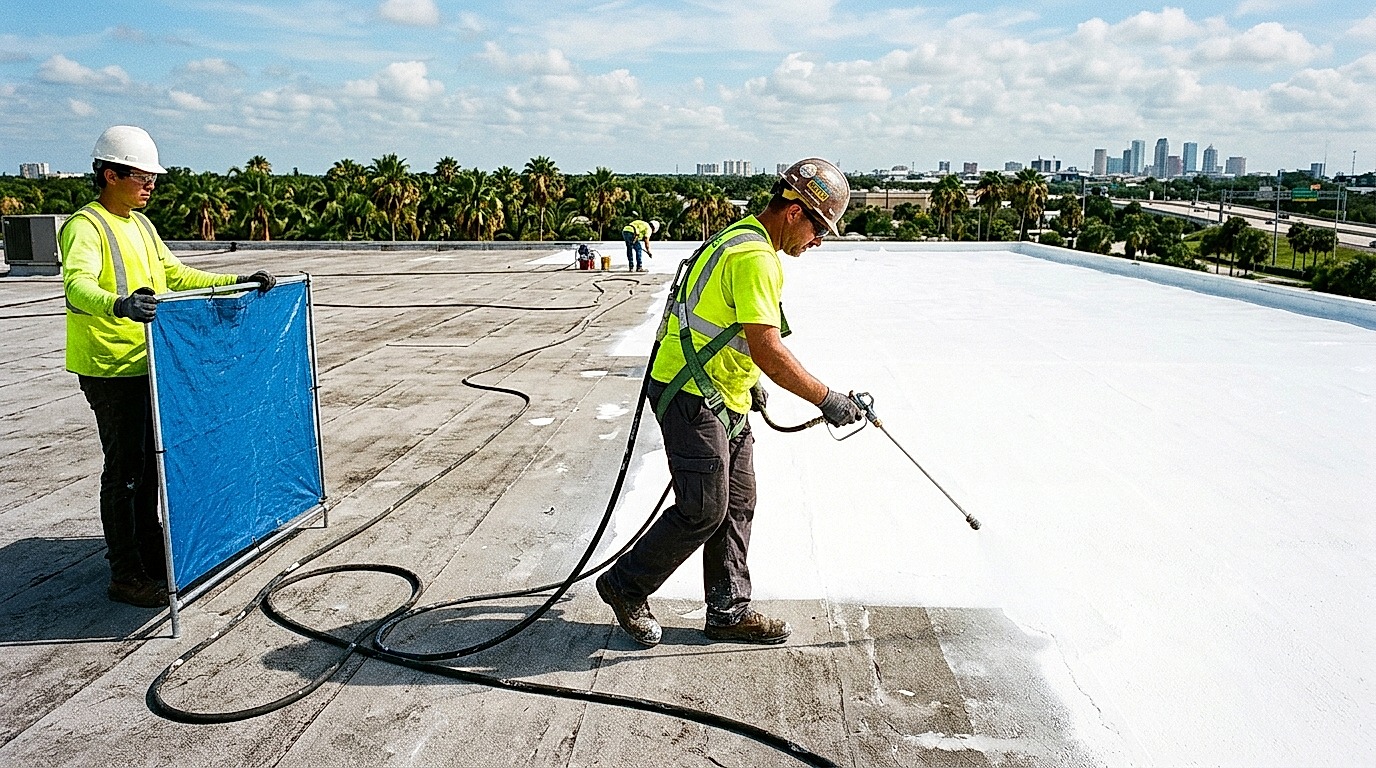
When a commercial roof starts leaking, developing blisters, or showing widespread wear, property owners face an important decision: should they restore the existing roof with a coating, or invest in a complete replacement?
Executive Briefing: Commercial Coating vs. Replacement
- Cost Savings Potential: A fluid-applied restoration coating typically costs 40% to 60% less than a full tear-off and replacement.
- The Moisture Boundary: If more than 20% to 25% of the underlying insulation core contains moisture, full replacement is required.
- Drainage & Slope: Coatings seal surfaces but cannot fix severe ponding or inadequate slope without prior tapered crickets.
- Tax & Warranty Advantages: High-performance coatings can often be expensed in the year installed and extend warranty coverage 10 to 20 years.
Choosing incorrectly can be expensive. A coating applied over wet insulation or an unsuitable roof surface may fail to solve the underlying problem. On the other hand, replacing an entire roof when the damage is limited to a few repairable areas may involve more work than the building actually needs.
The right decision depends on the condition of the existing roof, the extent of moisture damage, drainage performance, the building's use, and the suitability of the proposed roofing system.
For Tampa commercial properties, these questions matter before approving a major roofing project. Heavy rainfall, strong sunlight, humidity, and severe-weather exposure make it important to evaluate both the existing roof and the system being proposed.
This guide explains when commercial roof coating may be appropriate, when replacement deserves serious consideration, and how to choose a roofing material that fits your building rather than simply selecting the cheapest or most commonly advertised option.
Commercial Roof Coating vs. Roof Replacement: What Is the Difference?
Both options can address an aging commercial roof, but they involve different scopes of work and are suitable for different conditions.
What Is Commercial Roof Coating?
A commercial roof coating is a high-solids, liquid-applied product installed over an eligible, properly prepared existing roof surface. Depending on the product and roofing assembly, our specialized commercial roof coating service helps protect the surface from harsh ultraviolet radiation, seals minor micro-cracks, and extends the service life of an eligible roof.
However, a coating is not a substitute for correcting underlying defects. The existing surface must be suitable for the selected product, necessary localized repairs must be completed, and moisture or drainage problems must be addressed as required by the manufacturer.
Coatings may be considered for certain existing flat and low-slope roof assemblies, including some single-ply membranes (such as TPO or PVC), built-up roofing (BUR), modified bitumen, or commercial metal roofs. Eligibility depends on the actual substrate, its physical adhesion condition, product compatibility, and engineering requirements.
What Is Commercial Roof Replacement?
Commercial roof replacement involves removing and replacing some or all of the existing roofing assembly, depending on project engineering and local Florida Building Code requirements.
Through our comprehensive commercial roof replacement service, the work may include tearing off aged roofing plies, inspecting and repairing structural steel or wood decking, replacing moisture-compromised rigid polyiso insulation, improving drainage taper, and installing a completely new, code-compliant roofing system.
Replacement provides an opportunity to address defects that a surface coating cannot resolve, including widespread wet insulation, deck corrosion, or severe framing sag. The actual scope should be established after performing non-destructive moisture scans and determining what needs to be repaired or replaced.
| Decision Factor | Roof Coating (Restoration) | Roof Replacement (Tear-Off) |
|---|---|---|
| Existing roof condition | Must be structurally sound and suitable for restoration | Recommended when the assembly has extensive rot, deck failure, or widespread embrittlement |
| Wet insulation | Requires moisture detection; damaged wet cores must be extracted and replaced before coating | Allows all compromised insulation boards to be addressed as part of the total tear-off scope |
| Drainage problems | Does not automatically correct poor slope or ponding without prior tapered crickets | Provides an opportunity to re-engineer roof slope with positive 1/4 inch per foot taper |
| Project scope & disruption | Minimal business interruption; fast fluid application with no heavy tear-off noise | Involves removal equipment, dumpster staging, deck repairs, and multi-week operational phases |
| Cost comparison | Significantly lower upfront capital expenditure; eligible for immediate tax expensing | Higher capital investment involving labor, disposal, insulation, and new membrane assemblies |
| Best next step | Perform adhesion tests and core moisture scans to confirm substrate eligibility | Establish the full extent of structural deterioration and request an engineered replacement proposal |
Do not choose a coating or replacement based on roof age or a salesperson's quick visual impression alone. Establish the physical condition of the underlying assembly through non-destructive moisture scans before making a financial commitment.
When Is Commercial Roof Coating a Good Option?
A coating may be worth considering when the existing roof remains suitable for restoration and its underlying problems can be corrected without replacing the entire assembly. Before approving a proposal, verify that the following five conditions are met:
Sound Underlying Assembly
Correctable Seams & Penetrations
Verified Chemical Compatibility
Resolvable Drainage Pathways
Clear Warranty Terms and Documented Restoration Scope
When Should a Commercial Roof Be Replaced Instead of Coated?
A coating is not the right solution for every aging roof. Applying fluid coating over a fundamentally compromised roof assembly wastes capital and leads to trapped moisture failures. Look for these five clear indicators that mandate complete commercial replacement:
1. Widespread Wet Insulation
If thermal imaging or nuclear scanning reveals extensive wet insulation across more than 25% of the surface, a coating will trap that moisture against the deck, causing fungal rot and structural decay.
2. Compromised Structural Deck
Corroded corrugated steel decking, rotting plywood, or spalling concrete substrate cannot safely support rooftop equipment or pass Florida wind-uplift codes. Surface coatings provide zero structural strength.
3. Unresolvable Multi-Area Leaks
When water penetrates in multiple disconnected zones, it signals systematic membrane failure, aged lap adhesive breakdown, or widespread internal water migration that localized patches cannot resolve.
4. Severe Dead-Flat Drainage Sags
Persistent ponding resulting from building settling or lack of structural pitch cannot be cured by coating. Replacement allows installing tapered polyisocyanurate insulation to ensure positive drainage.
5. The Existing Roof Has Already Been Re-Coated or Exceeds Code Layers
Florida Building Code generally restricts low-slope commercial roofs to two existing roof systems. If a building already has two layers or an incompatible, degraded acrylic coating, applying another coating may violate code or cause severe adhesion failure. Full tear-off brings the building back into code compliance.
What Is the Best Commercial Roofing Material for a Tampa Building?
If your existing roof needs replacement, material selection should begin with the building's actual operational requirements, not a universal product ranking.
The best choice depends on roof slope, building use, rooftop equipment, drainage, grease exposure, energy efficiency goals, wind-uplift design, and long-term maintenance budgets. Below are the primary commercial systems evaluated by our engineering teams:
TPO Roofing: Energy-Efficient Single-Ply
Thermoplastic Polyolefin (TPO) is a popular single-ply membrane for low-slope roofs across Central Florida. Its bright white surface reflects solar heat, lowering cooling demands. TPO features hot-air heat-welded seams that create a continuous physical bond. Review our dedicated TPO roofing service and our guide on flat roof lifespan in Florida for full technical specifications.
PVC Roofing: Superior Grease and Chemical Resistance
Polyvinyl Chloride (PVC) single-ply membranes are engineered for restaurants, food processing facilities, and manufacturing plants where grease, animal fats, and harsh chemicals vent onto the roof. PVC remains flexible and fire-resistant. Explore our specialized PVC roofing service when evaluating roofs with commercial kitchen exhausts.
EPDM Roofing: Durable Rubber Membrane
Ethylene Propylene Diene Monomer (EPDM) is a synthetic elastomer membrane known for high elasticity and thermal shock resistance. While black EPDM absorbs heat, ballasted or coated assemblies perform reliably on suitable structures. Compare options through our EPDM roofing service.
Modified Bitumen: Multi-Ply Puncture Resistance
Modified bitumen uses polymer-modified asphalt plies reinforced with polyester or fiberglass mats. Available in self-adhered, cold-applied, or heat-welded multi-ply systems, it withstands heavy foot traffic from HVAC maintenance technicians. Learn more through our modified bitumen roofing service.
Built-Up Roofing (BUR): Proven Redundant Protection
Built-up roofing alternates multiple layers of asphalt or coal tar with reinforcing fabrics, topped with mineral surfacing or gravel ballast. While heavier than single-ply systems, BUR provides extraordinary puncture resistance. Explore our built-up roofing service for high-redundancy commercial applications.
Metal Roofing: Architectural Durability for Sloped Facilities
Architectural and structural standing-seam metal roofing systems deliver 40 to 60 years of service on suitable slopes. Engineered concealed fasteners and corrosion-resistant Galvalume coatings withstand high hurricane winds. Review our metal roofing service and metal roof lifespan guide for coastal properties.
How to Choose Between Commercial Roofing Materials
Use this decision matrix to narrow options before requesting a site-specific proposal:
| Roofing System | Primary Advantages | Critical Evaluation Questions |
|---|---|---|
| TPO | High solar reflectivity, heat-welded seams, cost-effective single-ply | What mil thickness (60 vs 80 mil) and wind-uplift fastening method are specified? |
| PVC | Exceptional grease, oil, and chemical resistance; high fire rating | Does rooftop exhaust contain grease or acids that require a chemical-resistant PVC formulation? |
| EPDM | High flexibility, resistance to hail impact, proven longevity | How will membrane laps and internal drains be detailed to prevent adhesive seam failure? |
| Modified Bitumen | Multi-ply redundancy, high resistance to technician foot traffic | Is a cold-adhesive or multi-ply torch application specified for optimal fire safety? |
| Built-Up (BUR) | Multiple waterproofing layers, tough gravel armor surfacing | Does the structural framing accommodate the higher dead load of multi-ply gravel ballast? |
| Metal Roofing | Longest lifespan (40+ years), superior hurricane wind resistance | Does the building have adequate roof slope and coastal salt-air corrosion protection? |
Commercial Roof Coating vs. Replacement: How Much Should You Compare?
The lowest initial bid rarely represents the best financial value. Comparing a coating estimate against a replacement quote requires evaluating the complete scope of work rather than the headline total.
Compare the Full Scope, Not Just the Starting Price
Ensure every proposal details necessary preparatory engineering. For detailed guidance on reviewing contractor bids, read our article on how to compare roofing estimates.
What a Complete Coating Proposal Must Include:
- High-pressure surface washing and bio-wash treatment
- Reinforced fabric detail flashing around curbs and penetrations
- Required adhesion testing and substrate primers
- Extraction and replacement of isolated wet insulation
- Specified dry film thickness (minimum 20 to 30 mils)
- Manufacturer labor and material warranty documentation
What a Complete Replacement Proposal Must Include:
- Complete tear-off and legal disposal of old materials
- Structural decking inspection and per-sheet unit pricing
- New tapered polyiso insulation and R-value compliance
- Commercial grade edge metal, scuppers, and coping caps
- Permit fees and municipal inspection scheduling
- Comprehensive manufacturer No Dollar Limit (NDL) warranty
Consider Disruption to Your Business Operations
A commercial roofing project can affect tenant parking, retail access, warehouse deliveries, and sensitive interior workspaces. Coating applications produce far less noise and zero debris disposal traffic, making restoration ideal for hospitals, hotels, and active retail centers. Conversely, full replacement requires staging cranes, roll-off dumpsters, and careful weather-contingency planning.
How to Check Whether Your Commercial Roof Is Suitable for Coating
Before signing a contract for a roof restoration project, require a documented field assessment that answers these five critical technical questions:
Physical Substrate Inspection
Has the contractor inspected membrane seam integrity, flashing transitions, expansion joints, and counterflashing across the entire roof surface?
Non-Destructive Moisture Survey
Was an infrared thermal imaging scan or electrical impedance moisture meter utilized to verify that the underlying insulation core is completely dry?
Field Pull-Adhesion Testing
Did the contractor apply test coating patches and perform calibrated pull-peel tests to confirm bonding strength to your existing membrane?
Drainage and Slope Evaluation
Have persistent low spots and scupper elevations been analyzed to prevent standing water from exceeding manufacturer warranty allowances?
Evidence-Backed Recommendation
Are the recommendations supported by high-resolution photographs, core moisture readings, and a transparent written scope of work?
Questions to Ask Before Approving a Commercial Roofing Project
Protect your commercial asset and capital budget by asking prospective roofing contractors these seven essential questions:
-
What exact condition is the existing roof assembly in? Request photographs of seams, flashings, and core testing results.
-
Why are you recommending coating over replacement (or vice versa)? Insist on a technical justification based on moisture and membrane conditions.
-
What surface preparation and seam repairs are included? Ensure power washing, primer application, and reinforcement fabric are written in the scope.
-
How will ponding water areas be corrected? Verify whether tapered crickets or auxiliary drains are included before applying fluid coatings.
-
What unit pricing applies if rotten decking or wet insulation is uncovered? Agree on written per-sheet and per-board replacement pricing beforehand.
-
Is the proposed system certified by the material manufacturer? Confirm the contractor is an authorized applicator eligible to issue manufacturer warranties.
-
What are the annual maintenance requirements to keep the warranty active? Understand inspection schedules and owner obligations.
Frequently Asked Questions
Can you coat a leaking commercial roof?
A roof with leaks may still be eligible for restoration, but the leak sources must be investigated and all necessary repairs completed prior to coating. Coating over unresolved leaks or moisture-damaged insulation will not solve the underlying problem.
Can roof coating fix ponding water?
A coating does not correct inadequate slope or level out depressions. While high-solids silicone coatings resist standing water degradation better than acrylics, structural drainage corrections must be completed before restoration.
What is the best commercial roofing material in Florida?
There is no single best material. TPO, PVC, EPDM, modified bitumen, built-up roofing, and metal are each appropriate in different applications depending on slope, chemical exposure, energy goals, and budget.
Is TPO better than PVC for a commercial building?
Both are single-ply membranes with heat-welded seams. TPO is typically more cost-effective for retail and warehouse facilities, while PVC offers superior resistance to animal fats, cooking grease, and harsh industrial exhaust.
When should a commercial roof be replaced instead of restored?
Replacement is necessary when the roof has widespread wet insulation (exceeding 25%), damaged structural decking, severe slope deficiencies, or deteriorated membranes that cannot provide a sound bonding base.
Is roof coating always cheaper than replacement?
A coating project avoids tear-off labor and landfill fees, making upfront costs 40% to 60% lower. However, if applied over undetected wet insulation, the system will fail prematurely and increase long-term life-cycle costs.
Does a commercial roof need to be completely dry before coating?
Yes. Both the surface and underlying insulation core must be thoroughly dry. Trapped moisture beneath liquid coatings creates blistering, pinholes, and delamination under intense Florida heat.